Electrician resume example
A complete resume for a journeyman electrician in commercial and industrial work, plus summaries, bullet points, skills and the licenses to list.
What hiring managers look for
Electrical contractors and foremen check your license class and state before they read anything else, then the kind of work you've done: residential, commercial, industrial or service. After that they want job sizes, the systems you've installed (services, switchgear, conduit, controls), whether you can read prints and lay out a job, and a clean safety record backed by OSHA and NFPA 70E training.
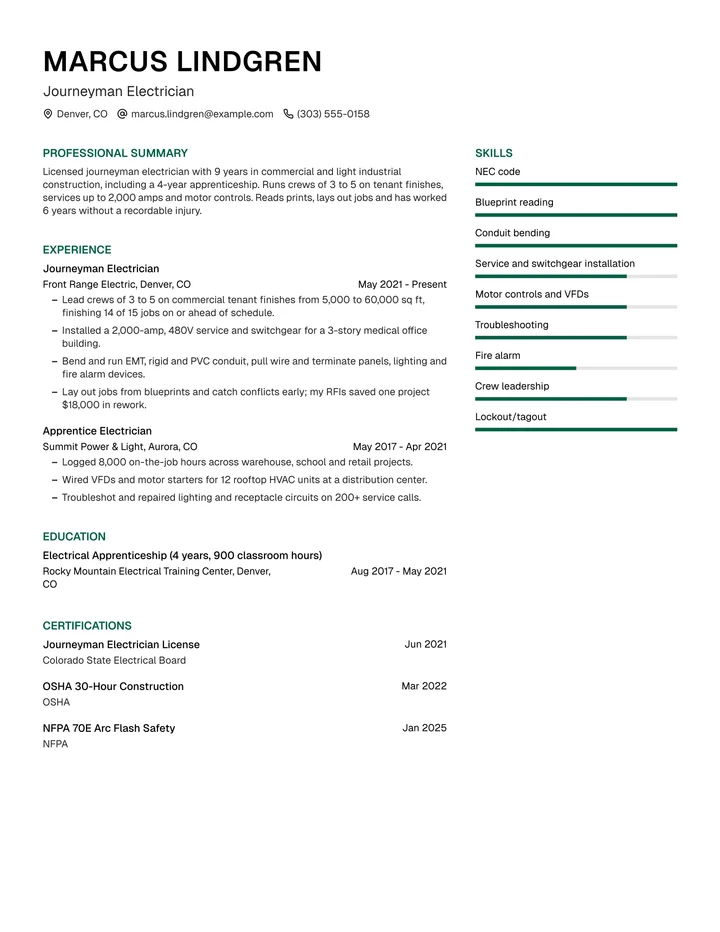
This example follows a journeyman with a four-year apprenticeship and five years as a licensed journeyman on commercial and light industrial jobs. Each project names the building, the scope and the size of the crew or the service, so a foreman can picture the work. Apprentices, residential wiremen, service techs and maintenance electricians can keep the layout and put their own jobs in it.
Electrician resume summary examples
Journeyman, 9 years
Licensed journeyman electrician with 9 years in commercial and light industrial construction, including a 4-year apprenticeship. Runs crews of 3 to 5 on tenant finishes, services up to 2,000 amps and motor controls. Reads prints, lays out jobs and has worked 6 years without a recordable injury.
Apprentice
Second-year electrical apprentice with 3,600 on-the-job hours in residential and light commercial work. Roughs in homes, pulls wire, mounts panels and bends EMT under a journeyman. OSHA 10 certified and on track to test for a journeyman license in 2029.
Master electrician
Master electrician with 15 years in industrial construction and 6 as a general foreman. Runs jobs of 25 electricians and $4M in labor, pulls permits, schedules inspections and has passed 40+ final inspections on the first visit.
Industrial maintenance
Maintenance electrician with 7 years in a food plant, keeping 3 production lines running. Troubleshoots PLCs, VFDs and conveyors, cut unplanned downtime by 30% and handles lockout/tagout for 60 machines.
Electrician resume bullet points
Strong bullets start with what you did and end with what changed. Borrow the pattern, then use your own numbers.
- Wired a 120-unit apartment building from rough-in to trim with a crew of 6, passing every inspection on the first visit.
- Upgraded 40 homes from 100-amp to 200-amp services, coordinating each shutoff with the utility.
- Installed 900 LED fixtures and occupancy sensors in a school retrofit that cut its lighting load by 55%.
- Diagnosed a recurring breaker trip at a bakery to a failing mixer motor, ending 3 weeks of lost production.
- Terminated 48 fiber and Cat6 drops and pulled power for a server room expansion over one weekend.
- Trained 4 first-year apprentices on conduit bending, box fills and safe work practices.
- Wrote and led weekly toolbox talks; the crew went 1,400 days without a lost-time injury.
- Installed EV chargers at 9 commercial sites, including load calculations and panel upgrades.
Skills for an electrician resume
Skills job postings ask for
- National Electrical Code (NEC)
- Blueprint and schematic reading
- Conduit bending (EMT, rigid, PVC)
- Service and panel installation
- Commercial and residential wiring
- Motor controls, VFDs and PLCs
- Troubleshooting with meters
- Lighting and controls
- Fire alarm and low voltage
- Lockout/tagout and arc flash safety
- Load calculations
Skills to show in your bullets
- Problem-solving
- Leading a crew
- Safety focus
- Clear communication with other trades
- Reliability
List the skills a posting names in its own words, and only the ones you can talk about in an interview. Qualities like these read best as results in your bullets, not as a list.
Tips for writing an electrician resume
- 1
Put your license in the headline
"Journeyman Electrician" or "Master Electrician" at the top, with the state in your certifications, gets you past the first filter. Apprentices should list their year and hours instead.
- 2
Describe jobs by size and scope
Square footage, amperage, voltage, the number of units and your crew size let a foreman judge your experience fast. "2,000-amp, 480V service" says more than "commercial wiring."
- 3
Show the work you can do alone
Layout from prints, troubleshooting, load calculations and running a crew separate a strong journeyman from one who needs direction. Give each its own bullet.
- 4
Count your safety record
Days without injury, OSHA and NFPA 70E training and lockout/tagout experience all matter to contractors with insurance and safety ratings on the line.
Licenses, hours and safety training
Electrical licensing is set by each state and sometimes by the city, so the license line on your resume must say where it's valid. Apprentices should show hours completed and the program, since many contractors pay and assign work by year. Keep safety cards current; some sites won't let you on without them.
- Your license class and state (apprentice, journeyman, master or contractor)
- Apprenticeship program and hours, such as 8,000 on-the-job and 900 classroom
- OSHA 10 or OSHA 30 Construction
- NFPA 70E arc flash training
- First aid, CPR and aerial lift or forklift certifications
- Specialty training such as fire alarm (NICET) or solar (NABCEP)
Make it yours

Talk instead of writing
Writing about yourself is hard. Talking is easy. A 25-minute call with the resume expert gets you a resume built from your best work.

Fit it to every job
Paste a job posting and get every line tailored to it, in the words the employer uses.

Know it gets read
See what an applicant tracking system reads in your resume, and what to fix, before you apply.

A cover letter to match
Get a cover letter written from your resume for the job you want, ready to send with it.