Police officer resume example
A complete resume for a patrol officer and field training officer, plus summaries, bullet points, skills and the certifications to list.
What hiring managers look for
Police hiring boards and promotion panels look first for state POST certification, years of sworn service and a clean disciplinary record. After that, they look at your assignments (patrol, traffic, K-9, SRO, investigations), the specialized training you hold, such as crisis intervention, de-escalation, DUI enforcement and firearms instruction, and evidence of good judgment: reports that hold up in court, community programs and commendations.
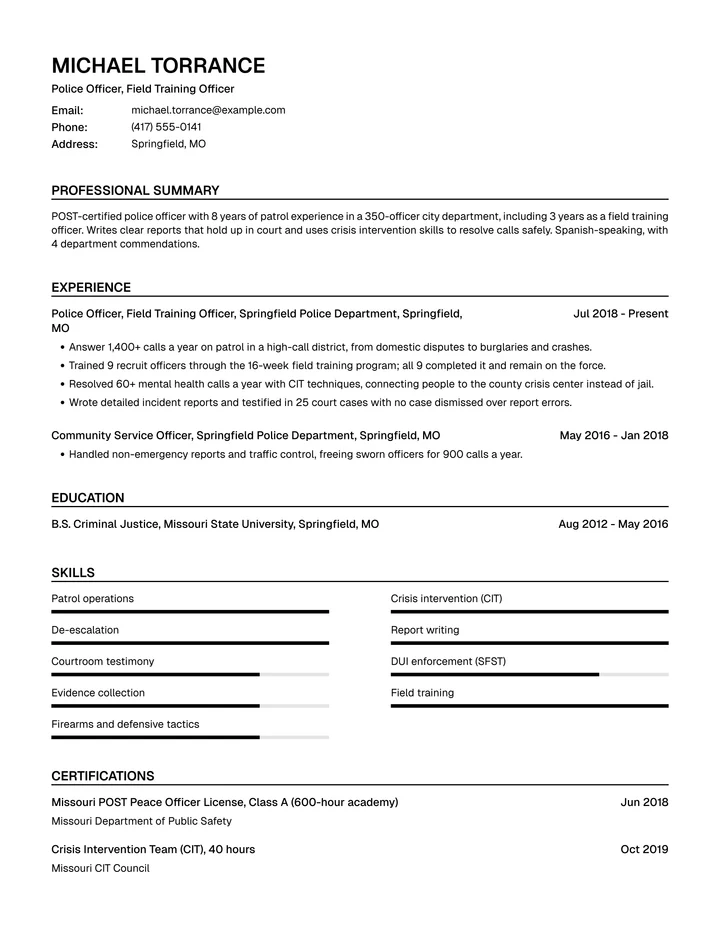
This example belongs to a patrol officer with eight years at a mid-size city department, including three as a field training officer. The classic one-column layout reads well to a civil service panel, lists training hours and certifications in their own section, and quantifies calls, arrests and community work without bragging. Officers applying for lateral transfers, detective or sergeant roles, or federal positions can use the same layout.
Police officer resume summary examples
Experienced, 8 years
POST-certified police officer with 8 years of patrol experience in a 350-officer city department, including 3 years as a field training officer. Writes clear reports that hold up in court and uses crisis intervention skills to resolve calls safely. Spanish-speaking, with 4 department commendations.
Academy graduate
Recent police academy graduate with a state POST license and a B.S. in criminal justice. Completed 640 academy hours with top marks in report writing and scenario training, served 4 years in the Army National Guard as a military police specialist and speaks conversational Spanish.
Detective
Detective with 12 years of service and 6 years in property and financial crimes. Carries 30 active cases at a time, writes search warrants and works with prosecutors, closing cases at a rate well above the unit average.
Military to law enforcement
Marine Corps veteran with 6 years of military police and security duty, applying for a sworn officer position. Brings experience with patrol, access control, use-of-force training and calm leadership in tense situations.
Police officer resume bullet points
Strong bullets start with what you did and end with what changed. Borrow the pattern, then use your own numbers.
- Made 48 DUI arrests in a year as part of a traffic safety grant, with every case accepted by the prosecutor.
- Talked a suicidal man down from a highway overpass using crisis negotiation training, earning the department's Life Saving Award.
- Started a monthly coffee-with-a-cop event that drew 40 to 60 residents and gave the district a direct line to neighbors.
- Recovered $85,000 in stolen property in a year by tracing pawn shop records and online listings.
- Taught 30 officers a year as a certified firearms instructor, with every officer passing qualification.
- Worked as a school resource officer for 2,100 students, cutting fights on campus by 35% over two school years.
- Processed crime scenes and collected evidence for 15 felony investigations that led to convictions.
- Reduced repeat calls to one apartment complex by 50% by working with management on lighting and trespass rules.
Skills for a police officer resume
Skills job postings ask for
- Patrol and call response
- Crisis intervention and de-escalation
- Report writing
- Courtroom testimony
- Traffic and DUI enforcement (SFST)
- Evidence collection and chain of custody
- Firearms and defensive tactics
- Body-worn cameras and CAD/RMS
- Constitutional law and use-of-force policy
- First aid and Narcan
Skills to show in your bullets
- Judgment under pressure
- Clear communication
- Integrity
- Empathy
- Teamwork with other agencies
List the skills a posting names in its own words, and only the ones you can talk about in an interview. Qualities like these read best as results in your bullets, not as a list.
Tips for writing a police officer resume
- 1
Put certification and service up front
Your POST license, academy hours and years of sworn service decide whether you're eligible. List them in your summary and give certifications their own section.
- 2
Show judgment, not just arrests
Panels want officers who use force rarely and solve problems well. Crisis calls resolved, community programs and repeat calls reduced show the kind of judgment departments value.
- 3
Translate the jargon
CAD, RMS, SFST and CIT are clear to a police panel but not to an HR screener or a federal agency. Spell out each one the first time, then use the short form.
- 4
List training by name and hours
Specialized courses such as CIT, firearms instructor, accident reconstruction or interview techniques open doors to special units. Include the hours for longer courses.
Certifications and training to list
Departments check certifications closely during background and promotion reviews. List your POST license first, then specialized training, each with the issuing agency and year, and keep a separate full training log ready to share.
- State POST peace officer license, with the class
- Police academy name and total hours
- Crisis Intervention Team (CIT) and de-escalation training
- Standardized Field Sobriety Testing (SFST) and radar or lidar
- Field training officer (FTO) certification
- Firearms, Taser or defensive tactics instructor certifications
Make it yours

Talk instead of writing
Writing about yourself is hard. Talking is easy. A 25-minute call with the resume expert gets you a resume built from your best work.

Fit it to every job
Paste a job posting and get every line tailored to it, in the words the employer uses.

Know it gets read
See what an applicant tracking system reads in your resume, and what to fix, before you apply.

A cover letter to match
Get a cover letter written from your resume for the job you want, ready to send with it.