Recruiter resume example
A complete resume for a corporate tech and operations recruiter, plus summaries, bullet points, skills and the metrics to track.
What hiring managers look for
Talent acquisition leaders read a recruiter's resume like a scorecard. They want the kinds of roles you fill (technical, healthcare, hourly, executive), how many hires you make a year, your time to fill and offer acceptance rate, and the tools you work in, such as Greenhouse, Workday, iCIMS and LinkedIn Recruiter. The best recruiters also show how they build pipelines, coach hiring managers and improve diversity of candidate slates.
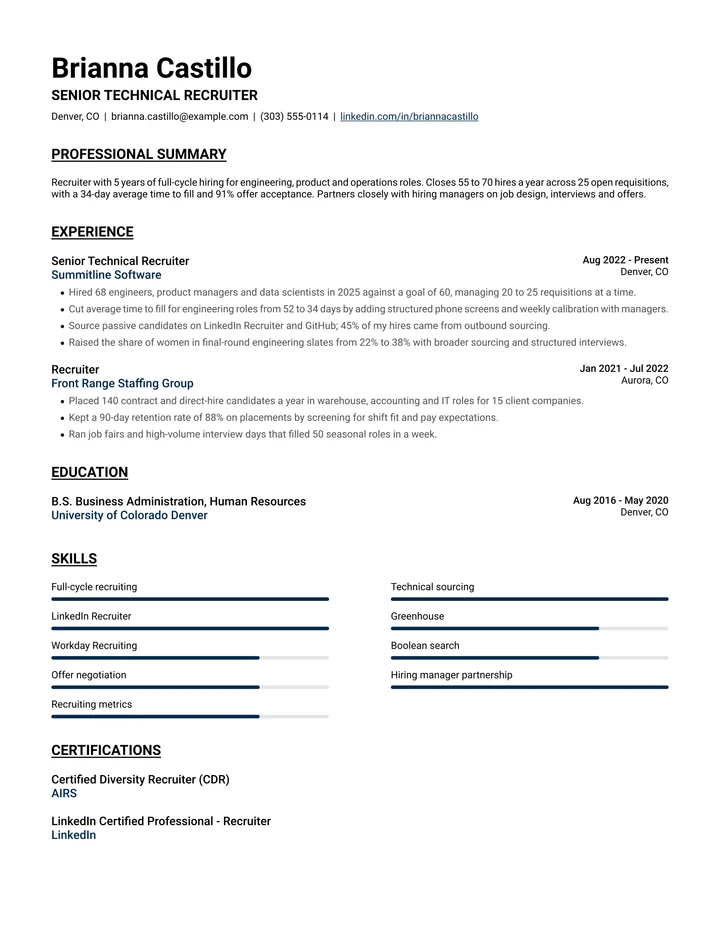
This example shows a corporate recruiter with five years across an in-house tech company and a staffing agency. The layout leads with a short summary and gives every job its hires, requisition load and speed numbers. Agency recruiters, sourcers, talent acquisition partners and HR coordinators moving into recruiting can use the same frame.
Recruiter resume summary examples
Mid-level, 5 years
Recruiter with 5 years of full-cycle hiring for engineering, product and operations roles. Closes 55 to 70 hires a year across 25 open requisitions, with a 34-day average time to fill and 91% offer acceptance. Partners closely with hiring managers on job design, interviews and offers.
New recruiter
HR coordinator with 2 years scheduling 40 interviews a week and running onboarding for a 900-person company, now moving into recruiting. Screens candidates for hourly and office roles, writes job posts and knows Workday and LinkedIn Recruiter well.
Agency recruiter
Agency recruiter with 6 years placing nurses and allied health professionals at 30 hospitals. Billed $1.1M in placement fees last year, keeps a bench of 400 active candidates and is known for quick shortlists that hiring managers trust.
Head of talent
Talent acquisition manager with 10 years in fast-growing companies, leading a team of 6 recruiters and coordinators. Built the hiring process, employer brand and recruiting analytics that took a startup from 120 to 600 employees in 3 years.
Recruiter resume bullet points
Strong bullets start with what you did and end with what changed. Borrow the pattern, then use your own numbers.
- Filled a hard-to-hire security engineering role in 21 days after it had been open for 5 months.
- Built a talent pool of 1,200 software engineers in Greenhouse, cutting sourcing time on repeat roles in half.
- Saved $260,000 a year in agency fees by moving all mid-level hiring in-house.
- Trained 45 hiring managers on structured interviews and scorecards, which raised interview-to-offer rates by 15%.
- Launched a referral program that grew to 30% of all hires within a year.
- Negotiated 50+ offers a year, keeping acceptance above 90% while staying inside pay bands.
- Hired 200 seasonal warehouse associates in 6 weeks using text-to-apply and same-day offers.
- Built a weekly recruiting dashboard in Looker that showed pipeline health for every department.
Skills for a recruiter resume
Skills job postings ask for
- Full-cycle recruiting
- Sourcing and Boolean search
- Applicant tracking systems (Greenhouse, Lever, Workday, iCIMS)
- LinkedIn Recruiter
- Phone and video screening
- Structured interviewing
- Offer negotiation
- Recruiting metrics and reporting
- Employer branding
- High-volume hiring
- Employment law basics (EEO, OFCCP)
Skills to show in your bullets
- Relationship building
- Persuasion
- Organization
- Clear communication with managers
- Candidate experience
List the skills a posting names in its own words, and only the ones you can talk about in an interview. Qualities like these read best as results in your bullets, not as a list.
Tips for writing a recruiter resume
- 1
Lead with hires and time to fill
Recruiting leaders think in hires per year, requisition load, time to fill and offer acceptance. Put your numbers in the summary and every job.
- 2
Say what kinds of roles you fill
Technical, healthcare, sales, hourly and executive recruiting are different specialties. Naming yours helps the right team find you.
- 3
Show sourcing, not only screening
Many recruiters only process applicants. Bullets that show how many hires came from outbound sourcing or referrals prove you can find people who weren't looking.
- 4
Include how you improved the process
Structured interviews, manager training, better job posts and dashboards make a recruiting team faster and fairer. One or two process wins set you apart from recruiters who just fill seats.
Recruiting metrics to put on your resume
Talent leaders know these numbers by heart, so give them yours. Pick the three or four you track and that look strongest, and put them in your summary and bullets.
- Hires per year and open requisitions at once
- Time to fill or time to hire, in days
- Offer acceptance rate
- Share of hires from sourcing or referrals
- 90-day retention or quality of hire
- Diversity of candidate slates
- Agency fees saved or revenue billed
Make it yours

Talk instead of writing
Writing about yourself is hard. Talking is easy. A 25-minute call with the resume expert gets you a resume built from your best work.

Fit it to every job
Paste a job posting and get every line tailored to it, in the words the employer uses.

Know it gets read
See what an applicant tracking system reads in your resume, and what to fix, before you apply.

A cover letter to match
Get a cover letter written from your resume for the job you want, ready to send with it.