Software engineer resume example
A complete resume for a mid-level backend engineer, plus summaries, bullet points and skills you can adapt to your own stack.
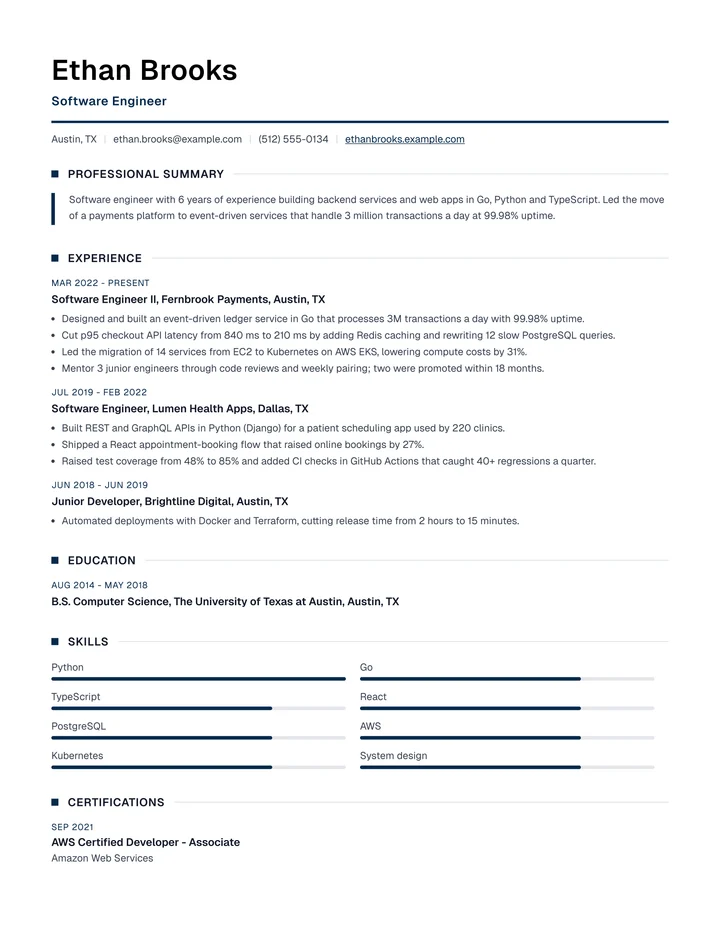
What hiring managers look for
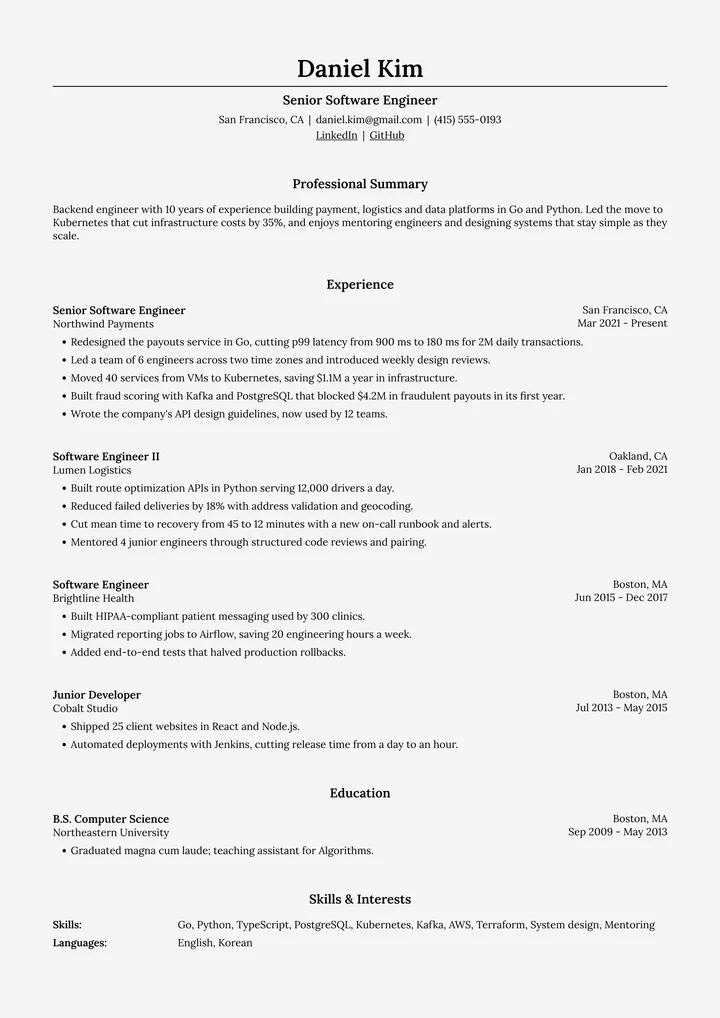
Hiring managers for software roles read a resume to answer three questions: what did you build, how big was it, and what got better because of you. The strongest resumes name the system, the scale and the result in each bullet, and list the stack in the posting's own words.
This example belongs to a backend engineer with six years of experience. It opens with a short summary, keeps each job to three or four results and lists skills a recruiter can match to the job ad in seconds. Front-end, full-stack and mobile engineers can keep the structure and swap in their own stack and numbers.
Software engineer resume summary examples
Mid-level, 6 years
Software engineer with 6 years of experience building backend services and web apps in Go, Python and TypeScript. Led the move of a payments platform to event-driven services that handle 3 million transactions a day at 99.98% uptime.
Entry level
Computer science graduate with two internships building REST APIs in Python and React front ends. Shipped a course-search feature used by 5,000 students and contributed fixes to two open-source libraries. Looking to grow as a backend engineer on a team that values code review and testing.
Full-stack, 5 years
Full-stack engineer with 5 years of experience in TypeScript, React and Node.js. Built the checkout flow behind $40M in yearly sales and cut page load times by 45%. Enjoys turning loose product ideas into small, well-tested releases.
Senior
Senior software engineer with 10 years of experience designing distributed systems in Java and Go. Led a team of 6 that rebuilt a search platform to serve 20,000 requests a second. Sets technical direction, writes design docs and grows engineers through mentoring.
Software engineer resume bullet points
Strong bullets start with what you did and end with what changed. Borrow the pattern, then use your own numbers.
- Reduced cloud costs by $180K a year by right-sizing Kubernetes workloads and moving batch jobs to spot instances.
- Built a feature flag service used by 40 engineers, so teams could release to 1% of users before a full rollout.
- Rewrote a legacy PHP billing module in TypeScript, ending 90% of billing-related support tickets.
- Cut build times from 22 to 6 minutes by caching dependencies and running tests in parallel in CI.
- Designed a data pipeline in Python and Kafka that ingests 50 GB of events a day for analytics.
- Led incident response for a payments outage and wrote the postmortem; the fixes prevented a repeat for 12 months.
- Raised the Lighthouse performance score from 52 to 94 by lazy-loading images and splitting the JavaScript bundle.
- Wrote the design doc and API contract for a mobile sync feature adopted by 3 product teams.
Skills for a software engineer resume
Skills job postings ask for
- Python
- Java
- Go
- JavaScript and TypeScript
- React
- Node.js
- SQL and PostgreSQL
- AWS, Azure or GCP
- Docker and Kubernetes
- CI/CD
- REST and GraphQL APIs
- System design
- Automated testing
- Git
Skills to show in your bullets
- Code review
- Design docs and clear writing
- Mentoring
- Ownership and on-call
- Working across teams
List the skills a posting names in its own words, and only the ones you can talk about in an interview. Qualities like these read best as results in your bullets, not as a list.
Tips for writing a software engineer resume
- 1
Lead with impact, not tasks
Recruiters skim for what changed because of your work: faster, cheaper, more reliable, more users. Put the number early in the bullet.
- 2
Match the stack in the posting
List the languages, frameworks and cloud tools the job asks for, in the same words, if you've used them. Recruiters and tracking systems both search for exact terms like Kubernetes or TypeScript.
- 3
Show scale and ownership
Requests per second, users, data volume and team size tell a reader how big your systems were. Say what you owned from start to finish.
- 4
Use projects only while experience is thin
Early in your career, add one or two projects with a link and the tech used. Once you have three or more years at work, let your jobs do the talking.
Make it yours

Talk instead of writing
Writing about yourself is hard. Talking is easy. A 25-minute call with the resume expert gets you a resume built from your best work.

Fit it to every job
Paste a job posting and get every line tailored to it, in the words the employer uses.

Know it gets read
See what an applicant tracking system reads in your resume, and what to fix, before you apply.

A cover letter to match
Get a cover letter written from your resume for the job you want, ready to send with it.