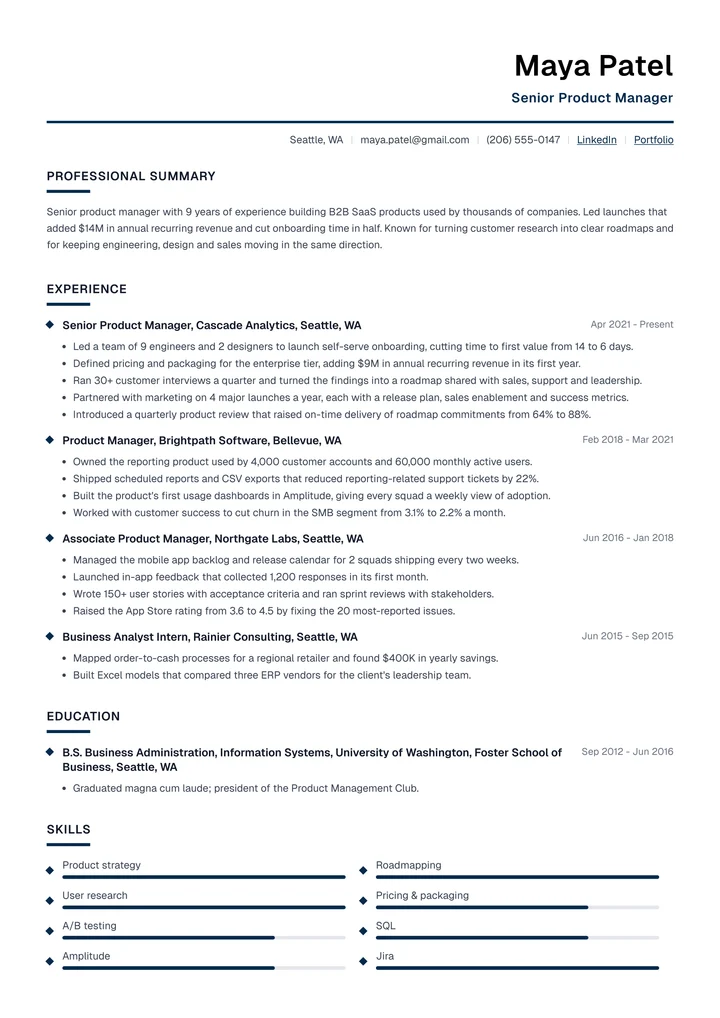
Medical assistant resume example
A complete resume for a certified medical assistant in family medicine and pediatrics, plus summaries, bullet points, skills and the certifications to list.
What hiring managers look for
Practice managers and lead MAs screen for a national certification first (CMA, RMA or CCMA), then look for the clinical work you can do without supervision: vitals, injections, EKGs, blood draws and point-of-care tests. Next comes the front-office side, because most clinics want an assistant who can also schedule, check insurance and work the EHR. The resumes that rise to the top show patient volume and a clean record on vaccines and specimens.
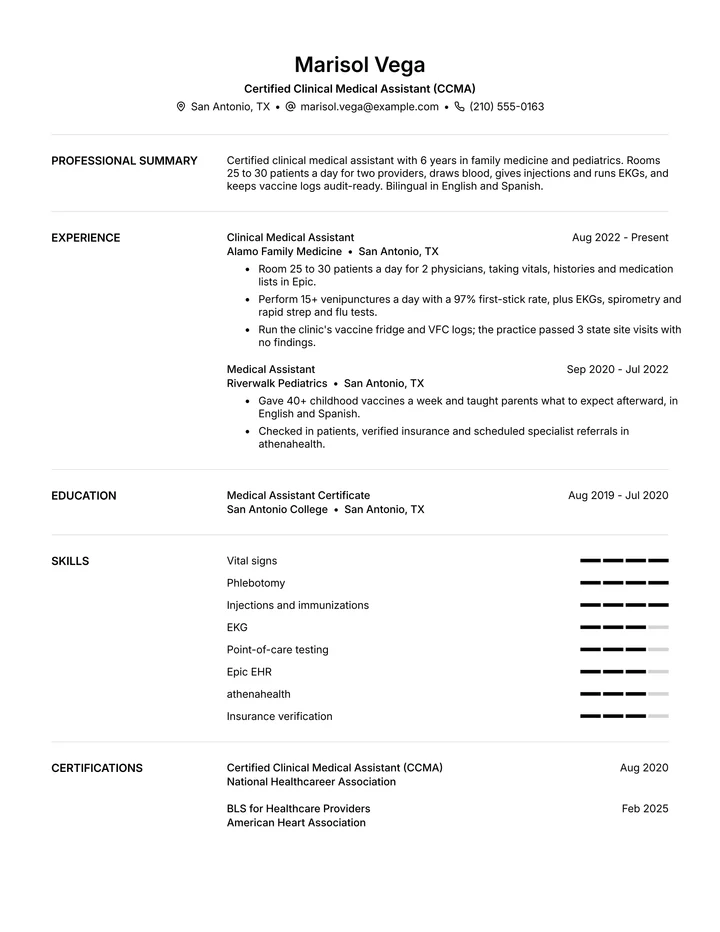
This example belongs to a CCMA with six years in family medicine and pediatrics. Clinical duties come first in every job, then the scheduling and referral work, with Epic and athenahealth named where a recruiter will search for them. Assistants in urgent care, dermatology, cardiology or OB-GYN can follow the same order and change the procedures.
Medical assistant resume summary examples
Mid-level, 6 years
Certified clinical medical assistant with 6 years in family medicine and pediatrics. Rooms 25 to 30 patients a day for two providers, draws blood, gives injections and runs EKGs, and keeps vaccine logs audit-ready. Bilingual in English and Spanish.
New graduate
Newly certified CMA (AAMA) who finished a 180-hour externship at a busy internal medicine office. Took vitals for 20 patients a shift, drew blood under supervision and charted in eClinicalWorks. BLS certified and eager to join a primary care team.
Specialty clinic
Registered medical assistant with 8 years in cardiology, running EKGs, Holter monitor hookups and stress test prep. Assists with 12 to 15 procedures a week and keeps device clinic records for 600 patients.
From front desk to clinical
Medical receptionist with 3 years of scheduling, check-in and insurance work, now a CCMA ready for a clinical role. Knows the practice side of patient care cold and brings new skills in phlebotomy, injections and EKGs.
Medical assistant resume bullet points
Strong bullets start with what you did and end with what changed. Borrow the pattern, then use your own numbers.
- Collected and labeled 3,000+ lab specimens a year with zero rejected for labeling errors.
- Assisted providers with 10 minor procedures a week, from skin biopsies to IUD insertions, setting up sterile trays.
- Raised the clinic's annual wellness visit rate by 18% by calling overdue Medicare patients during slow afternoons.
- Reconciled medication lists for every patient at intake, catching 60+ duplicate or outdated prescriptions in one year.
- Trained 5 new MAs on rooming flow, vaccine storage and Epic charting during their first month.
- Kept the exam rooms stocked and cleaned between visits, helping 2 providers stay on schedule through 28-patient days.
- Ran hemoglobin A1c, urinalysis and pregnancy tests under CLIA-waived rules and logged quality controls daily.
- Handled 50+ prescription refill requests a day, routing each to the right provider within 4 hours.
Skills for a medical assistant resume
Skills job postings ask for
- Vital signs and patient intake
- Phlebotomy and specimen collection
- Injections and immunizations
- EKG
- CLIA-waived testing
- Sterile procedure setup
- EHR (Epic, athenahealth, eClinicalWorks)
- Insurance verification
- Prior authorizations and referrals
- Scheduling
- HIPAA
- Medical terminology
Skills to show in your bullets
- Bedside manner
- Multitasking
- Attention to detail
- Teamwork with providers
- Clear communication
List the skills a posting names in its own words, and only the ones you can talk about in an interview. Qualities like these read best as results in your bullets, not as a list.
Tips for writing a medical assistant resume
- 1
Put your credential after your name or headline
"Marisol Vega, CCMA" or a headline with CMA (AAMA) or RMA tells a practice manager in one glance that you can give injections and chart in their state. Spell out the certifying body in your certifications section.
- 2
Split clinical and front-office work clearly
Many clinics hire for one side and want proof of the other. Lead each job with the hands-on clinical bullets, then add scheduling, insurance and referrals.
- 3
Give your daily patient volume
"Rooms 25 to 30 patients a day for 2 physicians" shows the pace you can keep. Add draws or vaccines per day or week if you track them.
- 4
Name the specialty and the EHR
Pediatrics, cardiology, dermatology and urgent care each use different procedures, so name yours. List the EHR by brand, since clinics on Epic or athenahealth search for it.
Certifications to list
A national certification is the first thing most employers check, and in some states it decides whether you may give injections. List the full name, the credential letters and the organization, followed by the year earned. Add any extras that match the clinic's specialty.
- Certified Medical Assistant, CMA (AAMA)
- Registered Medical Assistant, RMA (AMT)
- Certified Clinical Medical Assistant, CCMA (NHA)
- National Certified Medical Assistant, NCMA (NCCT)
- BLS for Healthcare Providers (American Heart Association)
- Phlebotomy or EKG technician certification, if you hold one
Make it yours

Talk instead of writing
Writing about yourself is hard. Talking is easy. A 25-minute call with the resume expert gets you a resume built from your best work.

Fit it to every job
Paste a job posting and get every line tailored to it, in the words the employer uses.

Know it gets read
See what an applicant tracking system reads in your resume, and what to fix, before you apply.
A cover letter to match
Get a cover letter written from your resume for the job you want, ready to send with it.