Data engineer resume example
A complete resume for a data engineer on a cloud warehouse and streaming stack, plus summaries, bullet points, skills and what to put in your projects.
What hiring managers look for
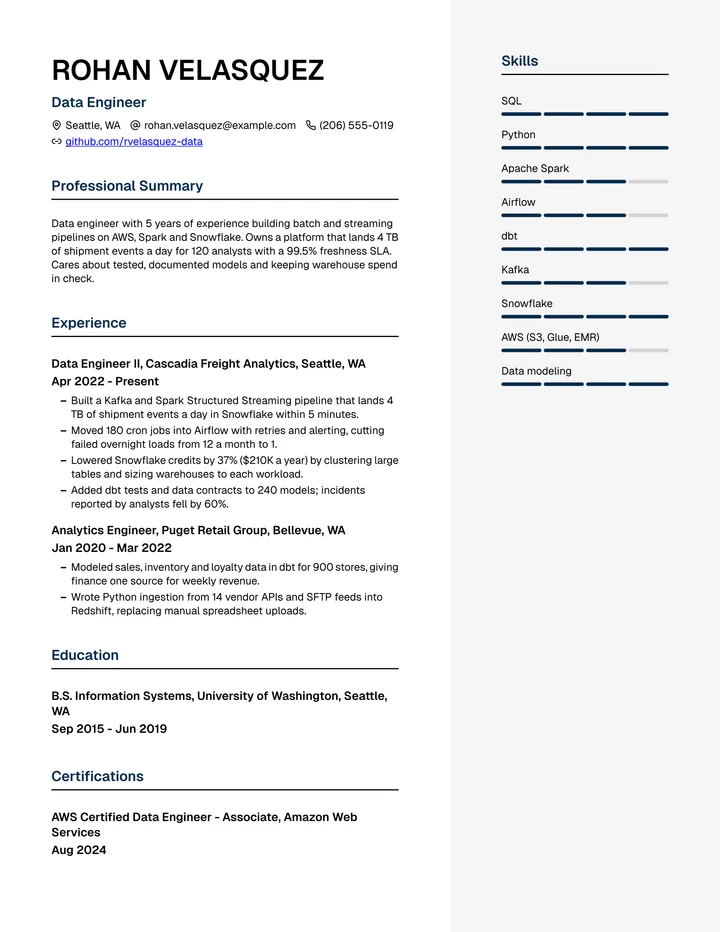
Hiring managers for data engineering read for the shape of your pipelines: where data comes from, how much of it, how it's transformed and who depends on it downstream. They scan for the stack in the posting, such as Spark, Airflow, dbt, Kafka, Snowflake or BigQuery, and then look for proof the data is trusted: freshness SLAs met, tests and data contracts, lower warehouse costs and fewer broken dashboards.
This example shows a data engineer with five years moving from analytics engineering to platform work at a logistics company. Each bullet names the system, the volume in rows, events or terabytes, and what improved for the analysts and data scientists using it. Analytics engineers, ETL developers and machine learning platform engineers can keep the layout and swap in their own stack.
Data engineer resume summary examples
Mid-level, 5 years
Data engineer with 5 years of experience building batch and streaming pipelines on AWS, Spark and Snowflake. Owns a platform that lands 4 TB of shipment events a day for 120 analysts with a 99.5% freshness SLA. Cares about tested, documented models and keeping warehouse spend in check.
Junior
Computer science graduate with an internship on a data platform team, where I wrote Airflow DAGs that load 30 million rows a night into BigQuery. Comfortable in SQL, Python and Docker, and built a public project that streams transit data through Kafka into Postgres.
Streaming specialist
Senior data engineer with 9 years focused on real-time systems in Kafka, Flink and Kinesis. Designed a fraud-scoring stream handling 60,000 events a second with sub-second latency, and runs the team's on-call for 30 production topics.
From data analysis
Data analyst with 4 years of advanced SQL and Tableau work, moving into data engineering. Already maintains 50 dbt models and two Airflow pipelines for my team, and wants to own ingestion and the warehouse end to end.
Data engineer resume bullet points
Strong bullets start with what you did and end with what changed. Borrow the pattern, then use your own numbers.
- Designed a lakehouse on Databricks and Delta Lake that replaced 3 siloed warehouses and served 200 users from one catalog.
- Reduced a daily Spark job's cost by 70% by fixing data skew and switching to spot instances on EMR.
- Introduced Great Expectations checks that caught 25 bad upstream loads in a quarter before any dashboard showed them.
- Set up change data capture from 40 PostgreSQL tables with Debezium, retiring full nightly reloads.
- Wrote the team's data modeling standards and reviewed every new dbt model for 2 years.
- Delivered a feature store that cut model training data prep from 3 days to 4 hours for the ML team.
- Managed all pipeline infrastructure in Terraform, so a new environment came up in 20 minutes instead of a week.
- Masked PII across 600 columns to meet CCPA requirements without blocking analysts' access.
Skills for a data engineer resume
Skills job postings ask for
- SQL
- Python or Scala
- Apache Spark
- Airflow, Dagster or Prefect
- dbt
- Kafka and streaming
- Snowflake, BigQuery, Redshift or Databricks
- Data modeling (star schema, Data Vault)
- AWS, GCP or Azure data services
- Terraform and CI/CD
- Data quality testing
- Change data capture
Skills to show in your bullets
- Working with analysts and data scientists
- Documentation
- Ownership of production systems
- Cost awareness
- Clear trade-off decisions
List the skills a posting names in its own words, and only the ones you can talk about in an interview. Qualities like these read best as results in your bullets, not as a list.
Tips for writing a data engineer resume
- 1
Put a volume in every pipeline bullet
Rows a day, terabytes, events a second or number of sources tell the reader the scale you've handled. A pipeline for 10,000 rows and one for 4 TB a day are very different jobs.
- 2
Show who relied on your data
Name the downstream users: finance reports, ML models, a customer-facing dashboard. It shows your work mattered and that you understood the people using it.
- 3
Prove reliability and cost control
Freshness SLAs met, failed runs reduced and warehouse spend cut are the results data platform managers are judged on. Bullets that show them stand out from lists of tools.
- 4
Separate batch from streaming experience
Many postings want one or the other. Make clear which tools you've run in production for each, so a recruiter doesn't have to guess whether your Kafka was a side project.
Projects and certifications worth listing
Early in your career, one solid end-to-end project can stand in for the production experience you don't have yet. Later, cloud and warehouse certifications help most when a posting names that platform.
- An end-to-end pipeline on GitHub: ingestion, orchestration, transformation, tests and a README with a diagram
- A dbt project with documented models and tests on a public dataset
- A streaming demo with Kafka or Kinesis and a small dashboard on top
- SnowPro Core, Databricks Data Engineer Associate or Google Professional Data Engineer
- AWS Certified Data Engineer or Azure Data Engineer Associate
Make it yours

Talk instead of writing
Writing about yourself is hard. Talking is easy. A 25-minute call with the resume expert gets you a resume built from your best work.

Fit it to every job
Paste a job posting and get every line tailored to it, in the words the employer uses.

Know it gets read
See what an applicant tracking system reads in your resume, and what to fix, before you apply.
A cover letter to match
Get a cover letter written from your resume for the job you want, ready to send with it.