Front-end developer resume example
A complete resume for a front-end developer working in React and TypeScript, plus summaries, bullet points, skills and what to put in your portfolio.
What hiring managers look for
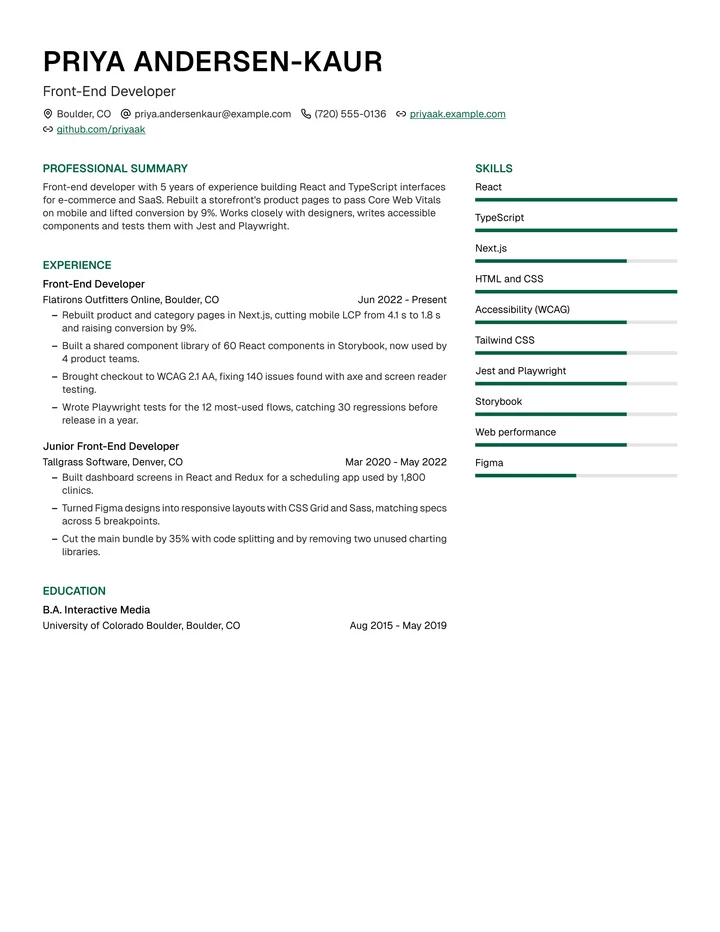
Hiring managers for front-end roles want to see the interfaces you've shipped and how well they work for real users. They look for the framework and language in the posting, usually React, Vue or Angular with TypeScript, then for evidence you care about the details users feel: Core Web Vitals, accessibility to WCAG 2.1 AA, conversion or task completion, and component libraries other developers reuse.
This example belongs to a developer with five years in React, working on an e-commerce storefront and before that a SaaS dashboard. Each bullet names the screen or component, the tool and a measured change in load time, accessibility or sales. UI engineers, design system developers and juniors with a strong portfolio can use the same layout.
Front-end developer resume summary examples
Mid-level, 5 years
Front-end developer with 5 years of experience building React and TypeScript interfaces for e-commerce and SaaS. Rebuilt a storefront's product pages to pass Core Web Vitals on mobile and lifted conversion by 9%. Works closely with designers, writes accessible components and tests them with Jest and Playwright.
Junior
Bootcamp graduate with a background in retail who builds responsive sites in React, TypeScript and Tailwind. Shipped a recipe app with offline support and a 98 Lighthouse accessibility score, and fixed 6 issues in an open-source date picker.
Design systems
Senior front-end engineer with 9 years of experience, the last 4 leading a design system used by 70 engineers across web and React Native. Set up visual regression testing, design tokens and contribution guidelines that halved UI bugs reported by QA.
From graphic design
Graphic designer with 6 years in brand and web work, now coding the layouts I used to hand off. Builds in HTML, CSS and React, keeps pixel-level fidelity to Figma, and brings a sharp eye for type, spacing and motion.
Front-end developer resume bullet points
Strong bullets start with what you did and end with what changed. Borrow the pattern, then use your own numbers.
- Migrated a 90,000-line AngularJS app to React over 10 months without pausing feature work.
- Raised the site's accessibility score from 64 to 100 by adding semantic HTML, focus states and ARIA labels.
- Designed a dark mode with CSS custom properties that 41% of users switched on in the first month.
- Reduced layout shift on the home page to 0.02 by reserving space for images and ads.
- Paired with 2 designers to ship a new onboarding flow that cut sign-up drop-off by 18%.
- Replaced a homegrown state store with React Query, deleting 4,000 lines and fixing stale data bugs.
- Localized the app into 6 languages with i18next, including right-to-left support for Arabic.
- Led front-end interviews and onboarded 5 developers with a starter guide to the codebase.
Skills for a front-end developer resume
Skills job postings ask for
- JavaScript and TypeScript
- React, Vue or Angular
- Next.js or Remix
- HTML5 and semantic markup
- CSS, Sass and Tailwind
- Responsive and mobile-first design
- Web accessibility (WCAG, ARIA)
- Core Web Vitals and performance
- Jest, Testing Library and Playwright
- Storybook and design systems
- REST and GraphQL
- Git and CI
Skills to show in your bullets
- Collaboration with designers
- Attention to visual detail
- User empathy
- Clear pull requests
- Pragmatism
List the skills a posting names in its own words, and only the ones you can talk about in an interview. Qualities like these read best as results in your bullets, not as a list.
Tips for writing a front-end developer resume
- 1
Measure what users feel
Load times, layout shift, accessibility scores and conversion are front-end results anyone can understand. Give before and after numbers when you have them.
- 2
Link to things people can click
A live site or a deployed demo shows your work faster than a description. Put the address as plain text near your name so it survives tracking systems.
- 3
Show you build for everyone
Accessibility is a requirement at many companies now. Name WCAG, screen readers and the tools you test with, and give a bullet to an accessibility fix you made.
- 4
Mention the components others reuse
A shared component or design system shows you write code for other developers, not only for one page. Say how many teams or screens depend on it.
What to put in your portfolio and GitHub
Front-end hiring managers usually click through before they call. Keep two or three of your best pieces at the top, each with a live link, the stack and one line on what was hard about it.
- Deployed projects with a working URL, not just screenshots
- A README for each repository with the stack, a screenshot and how to run it
- One project that shows accessibility work, such as keyboard navigation and screen reader support
- A component or small library with tests and Storybook stories
- Lighthouse scores or a short write-up of a performance fix
- Pinned repositories you're proud of; hide old class exercises
Make it yours

Talk instead of writing
Writing about yourself is hard. Talking is easy. A 25-minute call with the resume expert gets you a resume built from your best work.

Fit it to every job
Paste a job posting and get every line tailored to it, in the words the employer uses.

Know it gets read
See what an applicant tracking system reads in your resume, and what to fix, before you apply.

A cover letter to match
Get a cover letter written from your resume for the job you want, ready to send with it.