HVAC technician resume example
A complete resume for a residential and light commercial HVAC service technician, plus summaries, bullet points, skills and the certifications to list.
What hiring managers look for
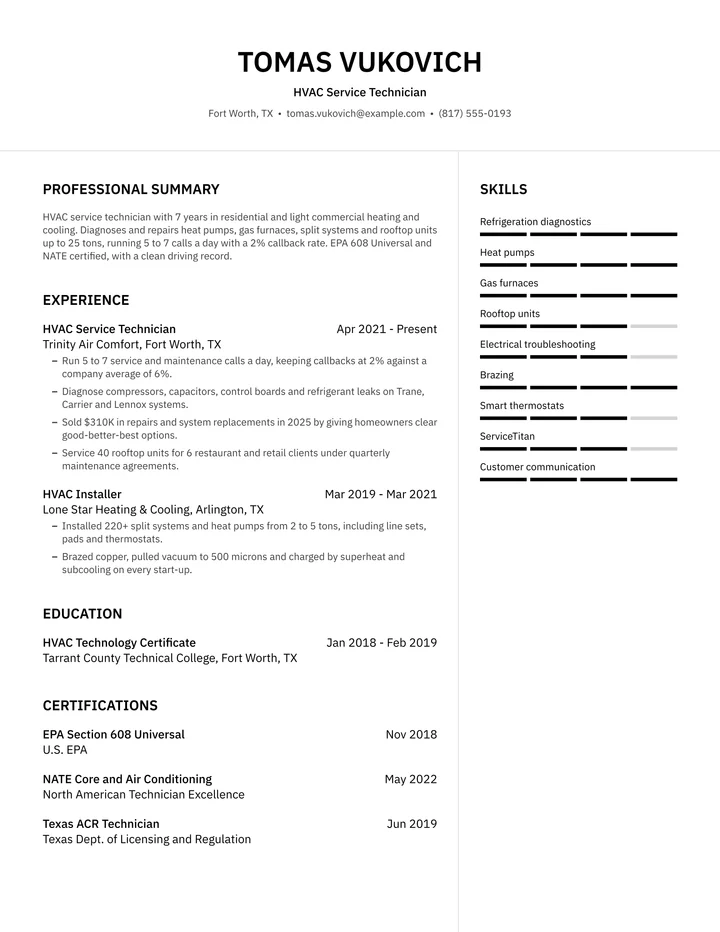
HVAC service managers check for an EPA Section 608 certification before anything else, because you can't legally handle refrigerant without it. Next they look at the equipment you know (split systems, heat pumps, furnaces, rooftop units, chillers), whether you install, service or both, how many calls you run a day, and your callback rate. A clean driving record matters too, since most techs drive a company van.
This example follows a service technician with seven years in residential and light commercial work, including two years as an installer before moving to service. Each bullet gives a count, a tonnage or a result, and the sidebar lists the meters, brands and controls a manager can match to their own trucks. Installers, refrigeration techs and building engineers can use the same layout.
HVAC technician resume summary examples
Mid-level, 7 years
HVAC service technician with 7 years in residential and light commercial heating and cooling. Diagnoses and repairs heat pumps, gas furnaces, split systems and rooftop units up to 25 tons, running 5 to 7 calls a day with a 2% callback rate. EPA 608 Universal and NATE certified, with a clean driving record.
Entry level
HVAC program graduate with 640 hours of shop training on furnaces, heat pumps and refrigeration trainers. EPA 608 Type II certified, comfortable in attics and crawl spaces, and ready to ride along with a senior tech while learning the company's service process.
Commercial refrigeration
Commercial refrigeration technician with 10 years on walk-in coolers, ice machines and grocery rack systems. Keeps 35 store accounts running, responds to after-hours alarms within an hour and has cut product-loss claims by 40% through preventive maintenance.
Changing careers
Former Navy machinist's mate moving into HVAC after 6 years maintaining pumps, compressors and shipboard air conditioning. Brings strong electrical and mechanical troubleshooting, safety discipline and an EPA 608 Universal card earned in service.
HVAC technician resume bullet points
Strong bullets start with what you did and end with what changed. Borrow the pattern, then use your own numbers.
- Replaced 9 failed compressors in one summer without a single warranty return.
- Traced a no-heat complaint on a 15-ton rooftop unit to a cracked heat exchanger and shut it down before a CO leak reached the dining room.
- Signed 180 homeowners to annual tune-up memberships, the second-highest count among 22 technicians.
- Retrofitted 14 R-22 systems with drop-in refrigerant, extending each system's life by an estimated 5 years.
- Commissioned 3 ductless mini-split projects of 8 heads each in a converted office building.
- Cut average time on site from 95 to 70 minutes by stocking the van from a parts-usage report.
- Balanced airflow across 22 supply registers in a two-story home, ending a 6-degree upstairs temperature gap.
- Mentored 2 apprentices through their first summer; both passed EPA 608 on the first try.
Skills for a HVAC technician resume
Skills job postings ask for
- EPA 608 refrigerant handling
- Heat pumps and split systems
- Gas and electric furnaces
- Rooftop units (RTUs)
- Superheat and subcooling charging
- Electrical schematics and controls
- Brazing and soldering
- Ductwork and airflow balancing
- Ductless mini-splits
- Preventive maintenance
- ServiceTitan or Housecall Pro
Skills to show in your bullets
- Explaining repairs to homeowners
- Working alone in the field
- Problem-solving
- Time management
- Professional appearance
List the skills a posting names in its own words, and only the ones you can talk about in an interview. Qualities like these read best as results in your bullets, not as a list.
Tips for writing a HVAC technician resume
- 1
Lead with your EPA 608 type
Say whether your card is Type I, II, III or Universal. Many postings filter on it, and Universal tells a commercial shop you can work on any size of system.
- 2
Give your callback rate
Callbacks cost a shop money and reputation, so a low rate is the clearest proof of good diagnostics. Compare it with the company average if you know it.
- 3
Separate install and service work
Installers and service techs are hired for different skills. If you've done both, give each its own job entry or bullets, with tonnage and system types for installs and calls a day for service.
- 4
Count what you sold, honestly
Most residential shops pay attention to repair and replacement sales and maintenance memberships. A number here shows you can earn a homeowner's trust as well as fix the unit.
Certifications, licenses and your driving record
HVAC hiring starts with refrigerant certification and, in many states, a technician or contractor license. Because nearly every tech drives a service van, a valid license and a clean record are usually part of the offer too.
- EPA Section 608 certification, with the type (I, II, III or Universal)
- Your state HVAC or ACR technician license, if your state issues one
- NATE certifications by specialty, such as air conditioning, gas heating or heat pumps
- Manufacturer training from brands like Carrier, Trane or Daikin
- OSHA 10 and any lift or confined-space training for commercial sites
- A valid driver's license with a clean record
Make it yours

Talk instead of writing
Writing about yourself is hard. Talking is easy. A 25-minute call with the resume expert gets you a resume built from your best work.

Fit it to every job
Paste a job posting and get every line tailored to it, in the words the employer uses.

Know it gets read
See what an applicant tracking system reads in your resume, and what to fix, before you apply.

A cover letter to match
Get a cover letter written from your resume for the job you want, ready to send with it.