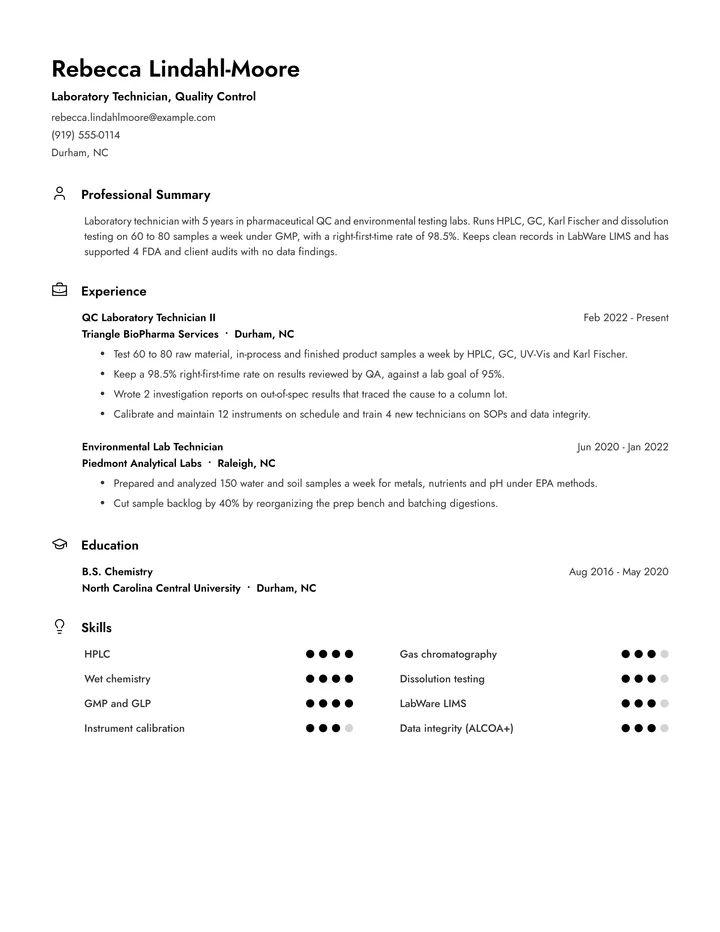
Lab technician resume example
A complete resume for a laboratory technician in a pharmaceutical quality control lab, plus summaries, bullet points, skills and the methods and instruments to list.
What hiring managers look for
Lab managers hiring a technician read for the type of lab you've worked in (clinical, QC, research, environmental or food), the methods and instruments you can run on your own, and how carefully you work. They look for sample volume and turnaround times, quality systems such as GLP, GMP, CLIA or ISO 17025, clean audit results, and whether you keep good records in a LIMS or electronic notebook and can troubleshoot an instrument before calling service.
This example belongs to a lab technician with five years in pharmaceutical quality control and environmental testing, running HPLC, GC and wet chemistry on 60 to 80 samples a week. Each bullet names a method or instrument with a volume or quality result. Research technicians, clinical lab assistants and food or environmental lab techs can keep the structure and swap in their own methods.
Lab technician resume summary examples
Mid-level, 5 years
Laboratory technician with 5 years in pharmaceutical QC and environmental testing labs. Runs HPLC, GC, Karl Fischer and dissolution testing on 60 to 80 samples a week under GMP, with a right-first-time rate of 98.5%. Keeps clean records in LabWare LIMS and has supported 4 FDA and client audits with no data findings.
New science graduate
Biology graduate with 2 years as an undergraduate research assistant, running PCR, gel electrophoresis, cell culture and ELISA. Keeps a careful lab notebook, prepares buffers and media, and is looking for a first technician role in a research or biotech lab.
Clinical lab
Medical laboratory technician, MLT (ASCP), with 6 years in a hospital core lab. Runs chemistry, hematology and urinalysis on Roche and Sysmex analyzers, handles 400 specimens a shift and keeps QC and CAP records ready for inspection.
Research technician
Research technician with 4 years in a university neuroscience lab, managing a mouse colony of 600 animals, running genotyping and assisting with imaging studies. Co-author on 3 peer-reviewed papers and responsible for ordering and lab safety.
Lab technician resume bullet points
Strong bullets start with what you did and end with what changed. Borrow the pattern, then use your own numbers.
- Validated a new HPLC method for an impurity test, cutting run time from 45 to 18 minutes.
- Processed 300 food samples a week for microbiology, including plating, incubation and colony counts.
- Kept the lab's chemical inventory of 900 items current in the LIMS, passing every safety inspection.
- Ran stability pulls and testing for 25 product lots across 4 storage conditions, never missing a pull date.
- Found a drifting balance during a routine check and led the recheck of 3 days of affected results.
- Extracted DNA from 2,000 tissue samples for a genotyping study with a 99% success rate.
- Rewrote 15 SOPs in plain step-by-step format, cutting documentation errors by 30%.
- Trained 6 summer interns on pipetting, aseptic technique and lab safety.
Skills for a lab technician resume
Skills job postings ask for
- HPLC and GC
- Wet chemistry and titrations
- UV-Vis and FTIR spectroscopy
- PCR, ELISA and cell culture
- Sample preparation
- GMP, GLP or CLIA
- LIMS and electronic lab notebooks
- Instrument calibration and maintenance
- SOPs and documentation
- Lab safety and chemical handling
- Data integrity
Skills to show in your bullets
- Attention to detail
- Patience with repetitive work
- Problem-solving
- Clear records
- Working independently
List the skills a posting names in its own words, and only the ones you can talk about in an interview. Qualities like these read best as results in your bullets, not as a list.
Tips for writing a lab technician resume
- 1
List methods and instruments by name
Lab managers screen for exact techniques: HPLC, GC-MS, PCR, ELISA, flow cytometry, Karl Fischer. Name the ones you can run on your own, and the instrument brand if it's common in your field.
- 2
Name the quality system
GMP, GLP, CLIA, CAP or ISO 17025 tells a manager you know how to document, review and defend results. Mention audits you supported and how they went.
- 3
Give volume and accuracy
Samples a week, turnaround time and right-first-time or error rates show both your pace and your care. Put them in your most recent job.
- 4
Match the lab type
Clinical, pharmaceutical, academic, environmental and food labs use different words. Mirror the posting's language, like specimens for clinical labs or samples and lots for QC.
Methods, instruments and certifications to list
A lab resume is read like a checklist of what you can run without supervision. Keep a clear list of techniques and instruments, and add any certifications your type of lab requires.
- Analytical methods: HPLC, GC, GC-MS, ICP, UV-Vis, FTIR, titrations
- Biology methods: PCR, qPCR, ELISA, cell culture, western blot
- Quality systems: GMP, GLP, CLIA, CAP or ISO 17025
- Software: LIMS such as LabWare or STARLIMS, Empower, electronic lab notebooks
- MLT or MLS (ASCP) for clinical labs
- Biosafety, bloodborne pathogens and hazardous materials training
Make it yours

Talk instead of writing
Writing about yourself is hard. Talking is easy. A 25-minute call with the resume expert gets you a resume built from your best work.

Fit it to every job
Paste a job posting and get every line tailored to it, in the words the employer uses.

Know it gets read
See what an applicant tracking system reads in your resume, and what to fix, before you apply.
A cover letter to match
Get a cover letter written from your resume for the job you want, ready to send with it.