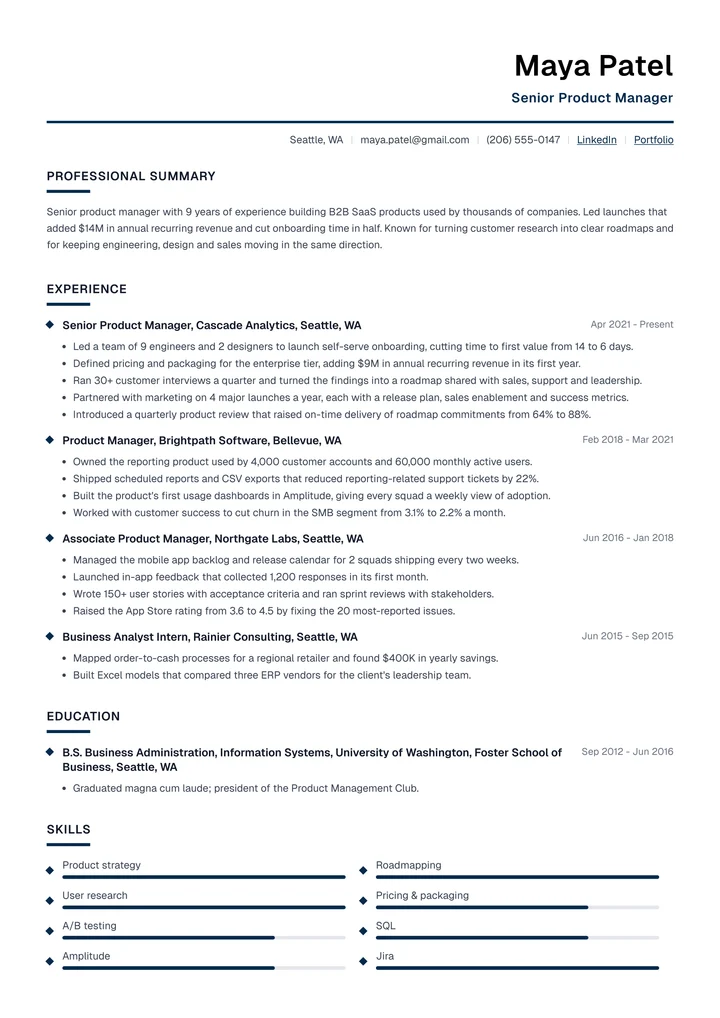
Phlebotomist resume example
A complete resume for a certified phlebotomist in a hospital lab, plus summaries, bullet points, skills and the certifications to list.
What hiring managers look for
Lab supervisors hiring a phlebotomist look for a national certification such as CPT or PBT, how many draws you do in a shift and how often you get the vein on the first stick. Then they check for the hard parts of the job: pediatric and geriatric patients, difficult veins, order of draw, specimen rejection rates and whether you can work the early morning hospital rounds.
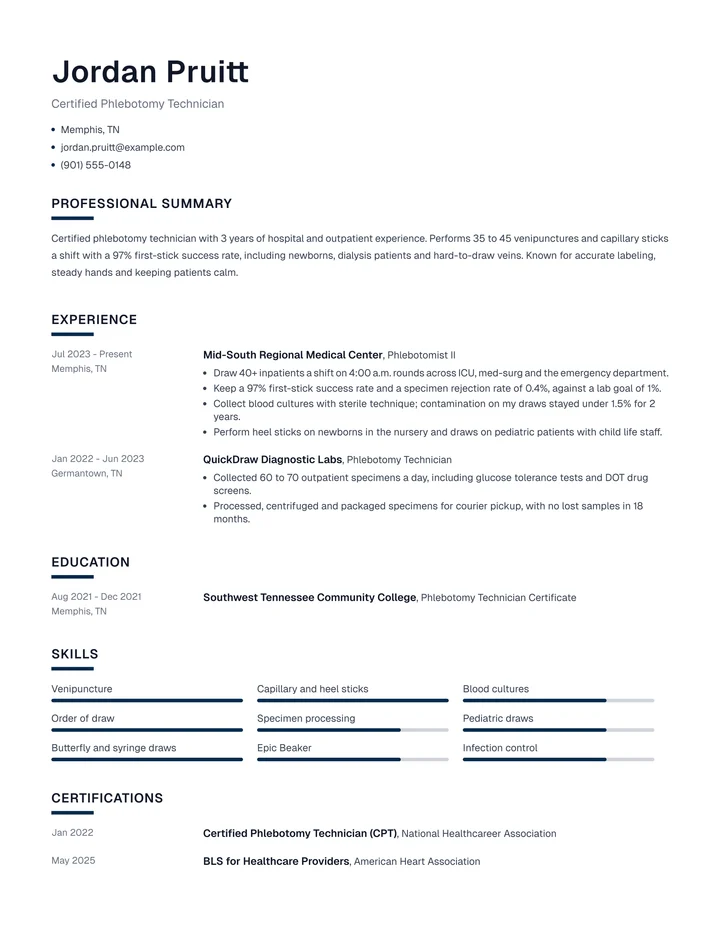
This example shows a certified phlebotomy technician with three years between a hospital and an outpatient draw station. The layout puts the certification and the numbers a lab cares about, such as 40 draws a shift and a 97% first-stick rate, near the top. Plasma center, mobile and blood bank phlebotomists can keep the order and change the setting.
Phlebotomist resume summary examples
Mid-level, 3 years
Certified phlebotomy technician with 3 years of hospital and outpatient experience. Performs 35 to 45 venipunctures and capillary sticks a shift with a 97% first-stick success rate, including newborns, dialysis patients and hard-to-draw veins. Known for accurate labeling, steady hands and keeping patients calm.
New phlebotomist
Newly certified phlebotomy technician with 120 successful venipunctures and 25 capillary sticks completed during a clinical externship. Trained in order of draw, labeling and OSHA bloodborne pathogen rules, and comfortable with early shifts and anxious patients.
Plasma center
Phlebotomist with 4 years in a plasma donation center, screening donors, starting 50 venipunctures a day and monitoring apheresis machines. Kept donor reactions well below center targets and trained 12 new technicians.
Moving into healthcare
Former retail shift lead who just earned a CPT certification. Brings 5 years of keeping lines moving and customers happy, now paired with 100+ supervised draws and careful specimen handling.
Phlebotomist resume bullet points
Strong bullets start with what you did and end with what changed. Borrow the pattern, then use your own numbers.
- Drew blood from 9,000+ patients in a year while keeping patient complaints at zero.
- Cut redraws on the night shift by 35% by labeling every tube at the bedside and double-checking two identifiers.
- Trained 6 new phlebotomists on butterfly needles, vein finders and pediatric positioning.
- Ran a mobile draw route to 14 nursing homes, collecting 55 specimens a morning before the lab's 10 a.m. cutoff.
- Processed and aliquoted 300 specimens a shift for chemistry, hematology and send-out testing.
- Collected chain-of-custody drug screens for 40 employer accounts with no rejected samples in a year.
- Helped the lab pass its CAP inspection by updating the collection manual and logging centrifuge maintenance.
- Used a vein finder and warm packs to raise first-stick success on oncology patients from 81% to 93%.
Skills for a phlebotomist resume
Skills job postings ask for
- Venipuncture
- Capillary and heel sticks
- Order of draw
- Blood culture collection
- Specimen labeling and processing
- Centrifuge operation
- Chain-of-custody drug screens
- Pediatric and geriatric draws
- Lab information systems (Epic Beaker, Cerner)
- OSHA bloodborne pathogens
- Patient identification
Skills to show in your bullets
- Steady hands
- Putting patients at ease
- Attention to detail
- Speed under pressure
- Reliability on early shifts
List the skills a posting names in its own words, and only the ones you can talk about in an interview. Qualities like these read best as results in your bullets, not as a list.
Tips for writing a phlebotomist resume
- 1
Put your first-stick rate in writing
Supervisors care how often you get the vein on the first try, because every miss means a second stick and an unhappy patient. If you track it, a figure like 97% belongs in your summary.
- 2
Name the patients who are hard to draw
Newborns, oncology and dialysis patients, and people with rolling or scarred veins take real skill. List the ones you handle so a hospital sees you can work any floor.
- 3
Show your specimen handling, not just the stick
Rejected and mislabeled samples cost the lab time and money. A low rejection rate, correct order of draw and careful processing are what separate a strong phlebotomist from an average one.
- 4
Count your draws
Daily or yearly draw totals show you can keep up in a busy lab or outpatient center. They also prove you've done far more than the minimum your certification required.
Phlebotomy certifications to list
Most hospitals and labs require a national certification, and California, Louisiana, Nevada and Washington also license phlebotomists. Put the full name, the agency and the date.
- Certified Phlebotomy Technician (CPT) from NHA
- Phlebotomy Technician (PBT) from ASCP
- Registered Phlebotomy Technician (RPT) from AMT
- National Certified Phlebotomy Technician (NCPT) from NCCT
- State license, such as California's CPT I or CPT II
- BLS for Healthcare Providers
Make it yours

Talk instead of writing
Writing about yourself is hard. Talking is easy. A 25-minute call with the resume expert gets you a resume built from your best work.

Fit it to every job
Paste a job posting and get every line tailored to it, in the words the employer uses.

Know it gets read
See what an applicant tracking system reads in your resume, and what to fix, before you apply.
A cover letter to match
Get a cover letter written from your resume for the job you want, ready to send with it.