Nurse practitioner resume example
A complete resume for a family nurse practitioner in primary and urgent care, plus summaries, bullet points, skills and the credentials to list.
What hiring managers look for
Medical directors and credentialing teams read an NP resume with a checklist in hand: national board certification (FNP-C, FNP-BC, PMHNP-BC, AGACNP-BC), an APRN license in their state, a DEA registration and the population focus that matches the job. After the paperwork, they want your setting, daily patient volume, panel size, procedures you do on your own and quality results such as diabetes or blood pressure control.
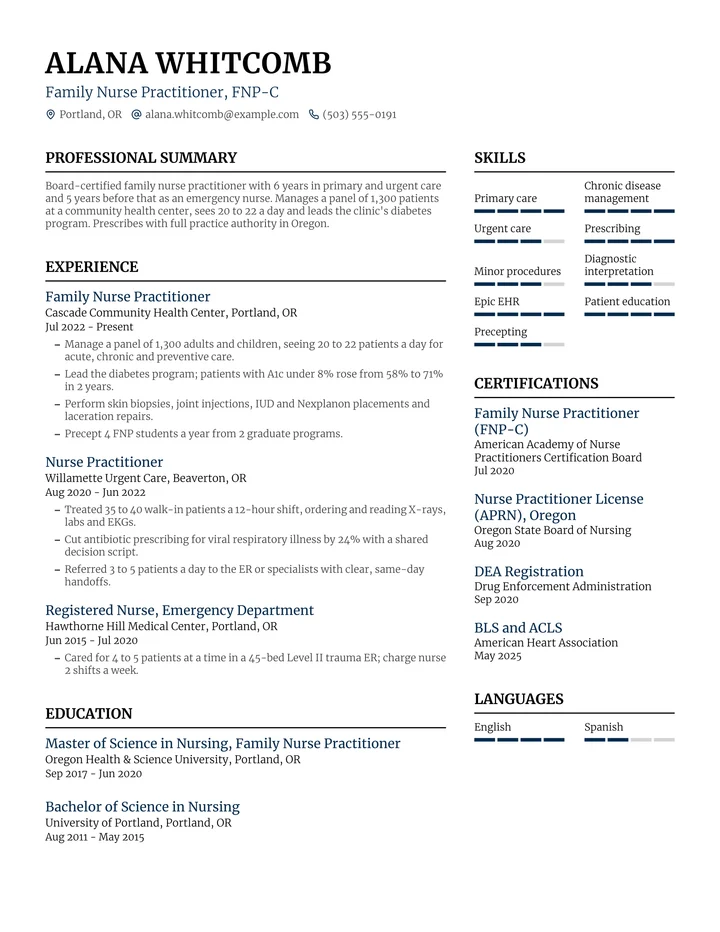
This example follows a family nurse practitioner with six years in a community health center and urgent care, after five years as an ER nurse. Credentials sit in their own section near the top, each NP job gives a patient count and a measurable outcome, and the RN years are shortened to one line. Psychiatric, acute care, pediatric and women's health NPs can reuse the format with their own population and metrics.
Nurse practitioner resume summary examples
Experienced, 6 years as an NP
Board-certified family nurse practitioner with 6 years in primary and urgent care and 5 years before that as an emergency nurse. Manages a panel of 1,300 patients at a community health center, sees 20 to 22 a day and leads the clinic's diabetes program. Prescribes with full practice authority in Oregon.
New graduate NP
Newly board-certified FNP with an MSN and 750 clinical hours in family practice, pediatrics and women's health. Brings 6 years of med-surg nursing and is ready for a primary care role with a structured onboarding period.
Psychiatric NP
Psychiatric mental health nurse practitioner (PMHNP-BC) with 5 years in outpatient and telehealth practice. Manages 60 medication follow-ups a week for depression, anxiety, ADHD and bipolar disorder, and offers buprenorphine treatment.
Acute care NP
Adult-gerontology acute care NP with 4 years on a hospitalist team, rounding on 14 to 16 inpatients a day. Places central lines, manages admissions overnight and helped trim average length of stay by half a day.
Nurse practitioner resume bullet points
Strong bullets start with what you did and end with what changed. Borrow the pattern, then use your own numbers.
- Raised colorectal cancer screening across the panel from 48% to 66% by adding FIT kits to every annual visit.
- Brought 72% of hypertensive patients to goal blood pressure through monthly nurse visits and medication titration.
- Launched a telehealth clinic that added 30 visits a week and cut no-shows by 40% for working parents.
- Diagnosed and stabilized 2 STEMI patients at urgent care, transferring both to the cath lab within 60 minutes.
- Wrote 5 clinical protocols on UTI, strep and asthma care adopted by 3 clinic sites.
- Started 120 patients on medication for opioid use disorder; 65% stayed in treatment past 6 months.
- Kept chart closure at 100% within 24 hours for 18 straight months.
- Ran a hepatitis C treatment program that cured 45 patients in primary care instead of referring out.
Skills for a nurse practitioner resume
Skills job postings ask for
- Physical assessment and diagnosis
- Prescribing and medication management
- Chronic disease management
- Preventive care and screening
- Ordering and reading labs and imaging
- Minor procedures
- Women's health
- Pediatrics
- Telehealth
- Epic, eClinicalWorks or Cerner
- Coding and documentation (E/M)
Skills to show in your bullets
- Clinical judgment
- Patient education
- Collaboration with physicians
- Cultural humility
- Calm decision-making
List the skills a posting names in its own words, and only the ones you can talk about in an interview. Qualities like these read best as results in your bullets, not as a list.
Tips for writing a nurse practitioner resume
- 1
Give credentials a section of their own
Board certification, APRN license, RN license, DEA registration and life support cards should be easy to find. Credentialing staff copy them straight from the page.
- 2
State your population focus clearly
An FNP, a PMHNP and an AGACNP are trained for different patients. Your headline should match the job's population so nobody has to guess.
- 3
Measure care the way clinics do
A1c control, blood pressure at goal, screening rates, panel size and visits per day are numbers a medical director reports on. Use yours.
- 4
Shorten your RN years
Keep one or two lines on your nursing background to show depth, then give the space to your NP work. New NPs can use more, with clinical rotations listed under education.
Licenses, certification and prescribing authority
An NP can't be scheduled until credentialing checks every license and registration, which can take months. List each one exactly as it's issued, with the state and the year, and note full practice authority or a collaborative agreement where it matters.
- National board certification: FNP-C (AANPCB) or FNP-BC, PMHNP-BC, AGACNP-BC (ANCC)
- APRN or NP license, by state
- RN license, by state or as a multistate compact license
- DEA registration and any state controlled-substance registration
- BLS, ACLS and PALS where required
- Buprenorphine prescribing experience, if relevant
Make it yours

Talk instead of writing
Writing about yourself is hard. Talking is easy. A 25-minute call with the resume expert gets you a resume built from your best work.

Fit it to every job
Paste a job posting and get every line tailored to it, in the words the employer uses.

Know it gets read
See what an applicant tracking system reads in your resume, and what to fix, before you apply.
A cover letter to match
Get a cover letter written from your resume for the job you want, ready to send with it.