Pharmacist resume example
A complete resume for a retail pharmacist in charge of a busy community pharmacy, plus summaries, bullet points, skills and the licenses to list.
What hiring managers look for
Pharmacy managers and directors check for a PharmD and an active license in their state, then for the setting you know: community, hospital, ambulatory care, long-term care or specialty. They want your volume, such as prescriptions verified a day, your immunization and testing credentials, and clinical work like medication therapy management, anticoagulation or antimicrobial stewardship. Leadership as a pharmacist in charge and audit results count for a lot too.
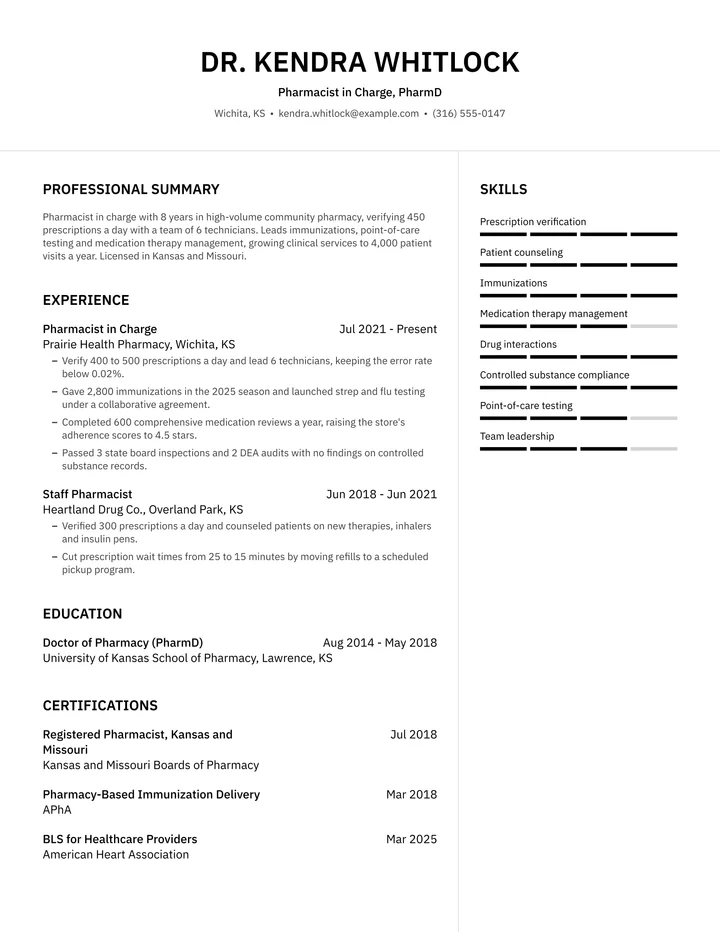
This example belongs to a pharmacist in charge with eight years in community pharmacy, verifying about 450 prescriptions a day and running a clinical services program. Bullets pair volume and accuracy with clinical outcomes, and every license is listed with its state. Hospital, clinical, specialty and new graduate pharmacists can follow the same layout.
Pharmacist resume summary examples
Experienced, 8 years
Pharmacist in charge with 8 years in high-volume community pharmacy, verifying 450 prescriptions a day with a team of 6 technicians. Leads immunizations, point-of-care testing and medication therapy management, growing clinical services to 4,000 patient visits a year. Licensed in Kansas and Missouri.
New PharmD graduate
PharmD graduate with 1,700 hours of advanced rotations in community, internal medicine, ambulatory care and oncology. Worked 3 years as a pharmacy intern, is certified to immunize and passed the NAPLEX and MPJE on the first try.
Hospital clinical pharmacist
Clinical pharmacist, BCPS, with 6 years in a 500-bed academic medical center. Rounds with internal medicine and ICU teams, manages pharmacy-to-dose vancomycin and anticoagulation, and helped cut broad-spectrum antibiotic days by 18% on the stewardship team.
Moving into industry
Community pharmacist with 10 years of patient care, moving into medical information or managed care. Brings deep drug knowledge, clear writing for patients and prescribers, and experience reviewing prior authorizations and formulary questions every day.
Pharmacist resume bullet points
Strong bullets start with what you did and end with what changed. Borrow the pattern, then use your own numbers.
- Caught a 10-fold dosing error on a pediatric antibiotic and called the prescriber before it reached the patient.
- Built a pharmacy-led anticoagulation clinic that kept 72% of warfarin patients in range, up from 58%.
- Trained 9 technicians for national certification; all 9 passed the PTCB exam.
- Reduced inventory on hand by $85K by setting new par levels and returning slow movers each month.
- Reviewed 180 inpatient orders a shift and made 25 to 30 clinical interventions on doses, duplications and interactions.
- Led a naloxone co-prescribing push that raised dispensing by 300% at 4 stores.
- Precepted 12 PharmD students on community rotations and served as an adjunct faculty member.
- Ran 40 blood pressure and A1c screening events at employers and churches across the county.
Skills for a pharmacist resume
Skills job postings ask for
- Prescription verification and DUR
- Patient counseling
- Immunization delivery
- Medication therapy management (MTM)
- Drug interactions and dosing
- Controlled substance and DEA compliance
- Sterile and non-sterile compounding
- Pharmacy systems such as EnterpriseRx or Epic Willow
- Point-of-care testing
- Insurance and prior authorizations
Skills to show in your bullets
- Accuracy under time pressure
- Clear patient education
- Leading technicians
- Judgment
- Collaboration with prescribers
List the skills a posting names in its own words, and only the ones you can talk about in an interview. Qualities like these read best as results in your bullets, not as a list.
Tips for writing a pharmacist resume
- 1
List every state license
Pharmacists are often hired to float between stores or states. Name each license and state, and mention reciprocity or a license in progress if you're relocating.
- 2
Show volume and accuracy together
Prescriptions verified a day shows pace, but managers want it paired with safety. Add your error rate, interventions or audit results next to the volume.
- 3
Give clinical services their own bullets
Immunizations, testing, MTM, anticoagulation and diabetes education are where pharmacy is growing. Count visits, shots or outcomes for each one you offer.
- 4
Add board certifications for clinical roles
Hospital and ambulatory care roles often ask for a residency and BPS certification such as BCPS or BCACP. Put residencies under education and certifications near the top.
Licenses, residencies and board certifications
A pharmacist's credentials tell an employer where you can practice and what clinical work you can take on. List each with the state or board and the year, and keep the order the posting uses.
- Your PharmD and school, and NAPLEX and MPJE if you're newly licensed
- Every state pharmacist license you hold
- PGY1 or PGY2 residencies, with the hospital and focus
- Board certifications such as BCPS, BCACP, BCOP or BCIDP
- APhA immunization certificate and any testing authority
- DEA or state controlled substance registrations for pharmacists in charge
Make it yours

Talk instead of writing
Writing about yourself is hard. Talking is easy. A 25-minute call with the resume expert gets you a resume built from your best work.

Fit it to every job
Paste a job posting and get every line tailored to it, in the words the employer uses.

Know it gets read
See what an applicant tracking system reads in your resume, and what to fix, before you apply.

A cover letter to match
Get a cover letter written from your resume for the job you want, ready to send with it.