Physical therapist resume example
A complete resume for a DPT in outpatient orthopedics, plus summaries for new grads and other settings, bullet points, skills and the credentials to list.
What hiring managers look for
Rehab directors and clinic managers check a physical therapist's state license and DPT first, then the setting: outpatient orthopedics, acute care, inpatient rehab, skilled nursing, home health or pediatrics. After that they look at caseload and productivity, such as visits a day, outcome scores like the LEFS or Oswestry, plan-of-care completion and Medicare documentation, and at board certifications such as OCS or NCS that mark a specialist.
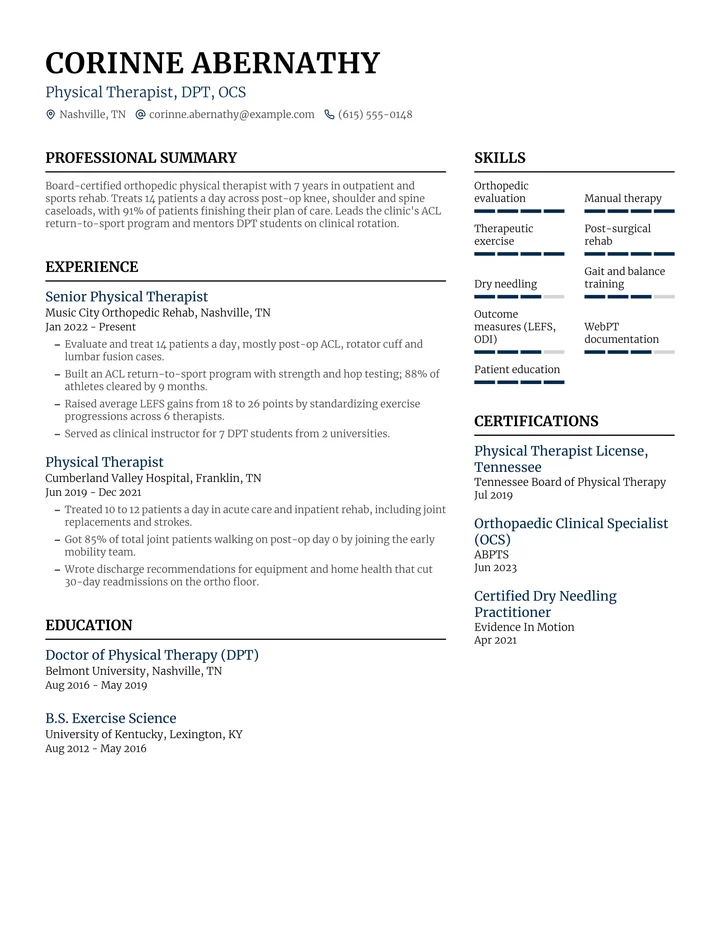
This example belongs to a DPT with seven years in outpatient orthopedics and sports rehab, board certified in orthopedics and the clinic's lead for its ACL return-to-sport program. Each bullet ties a treatment approach to a measured result, and the license and specialty sit at the top of the credentials. Acute care, neuro, pediatric, home health and travel therapists can use the same layout.
Physical therapist resume summary examples
Experienced, 7 years
Board-certified orthopedic physical therapist with 7 years in outpatient and sports rehab. Treats 14 patients a day across post-op knee, shoulder and spine caseloads, with 91% of patients finishing their plan of care. Leads the clinic's ACL return-to-sport program and mentors DPT students on clinical rotation.
New graduate
New DPT graduate with 36 weeks of clinical rotations in outpatient orthopedics, acute care and skilled nursing. Carried 80% of a full outpatient caseload in the final rotation and passed the NPTE on the first attempt. BLS certified and licensed in Ohio.
Neuro specialist
Neurologic Clinical Specialist with 9 years in inpatient rehab, treating stroke, spinal cord injury and brain injury patients. Uses body-weight support treadmill and FES training and helped raise the unit's average discharge FIM gain by 15%.
Home health
Home health physical therapist with 5 years treating older adults after falls, joint replacements and heart failure. Sees 6 patients a day across a rural county, completes OASIS documentation on time and cut fall recurrence among patients by a third with home safety visits.
Physical therapist resume bullet points
Strong bullets start with what you did and end with what changed. Borrow the pattern, then use your own numbers.
- Discharged 92% of low back pain patients at or under 10 visits while meeting their Oswestry goals.
- Lifted clinic productivity from 11 to 13.5 visits a day by moving to point-of-service documentation in WebPT.
- Started a fall prevention class for 40 seniors a month; participants improved Timed Up and Go times by 4 seconds on average.
- Kept Medicare documentation audit scores at 100% for 3 years by writing clear plans of care and progress notes.
- Partnered with 5 orthopedic surgeons on post-op protocols, growing referrals to the clinic by 30% in a year.
- Screened 300 high school athletes before the season and cut ankle sprains on two teams by half.
- Treated concussion patients with vestibular rehab, returning 90% to school or work within 6 weeks.
- Supervised 2 physical therapist assistants and signed off on 25 of their treatment notes a week.
Skills for a physical therapist resume
Skills job postings ask for
- Musculoskeletal and neurologic evaluation
- Manual therapy and joint mobilization
- Therapeutic exercise prescription
- Post-surgical rehab protocols
- Gait, balance and fall prevention
- Vestibular rehab
- Dry needling
- Outcome measures (LEFS, ODI, Berg)
- Medicare and insurance documentation
- EMR (WebPT, Epic, Net Health)
- Supervising PTAs and aides
Skills to show in your bullets
- Motivating patients
- Clinical reasoning
- Clear teaching
- Empathy
- Teamwork with physicians
List the skills a posting names in its own words, and only the ones you can talk about in an interview. Qualities like these read best as results in your bullets, not as a list.
Tips for writing a physical therapist resume
- 1
Write your credentials after your name
"Corinne Abernathy, PT, DPT, OCS" in the headline shows your license, degree and specialty before a reader reaches the first job. Follow the APTA order: license, highest degree, then board certification.
- 2
Name your setting and caseload
Outpatient, acute, inpatient rehab, SNF and home health are different jobs. Give the setting and how many patients you see a day, so a director can match you to the opening.
- 3
Report functional outcomes
Gains on the LEFS, Oswestry, Berg Balance or FIM, visits to discharge and plan-of-care completion are the numbers rehab managers report. One or two in each job show your treatment works.
- 4
Show teaching and program work
Clinical instructor roles, in-services you taught and programs you built, like a return-to-sport or fall prevention track, set you apart from therapists who only treat.
Licenses and board specialties to list
Every physical therapist needs a license from the state where they treat, earned by passing the NPTE. List each state license, note it if you practice under the PT Compact, and add board specialties from the ABPTS, which require clinical hours in the specialty and a separate exam.
- State PT license, and PT Compact privileges if you have them
- ABPTS board certification: OCS, SCS, NCS, GCS, PCS, CCS or WCS
- Residency or fellowship, such as an orthopedic residency or FAAOMPT
- Dry needling, vestibular, LSVT BIG or lymphedema (CLT) training
- APTA Credentialed Clinical Instructor
- BLS from the American Heart Association
Make it yours

Talk instead of writing
Writing about yourself is hard. Talking is easy. A 25-minute call with the resume expert gets you a resume built from your best work.

Fit it to every job
Paste a job posting and get every line tailored to it, in the words the employer uses.

Know it gets read
See what an applicant tracking system reads in your resume, and what to fix, before you apply.

A cover letter to match
Get a cover letter written from your resume for the job you want, ready to send with it.