EMT resume example
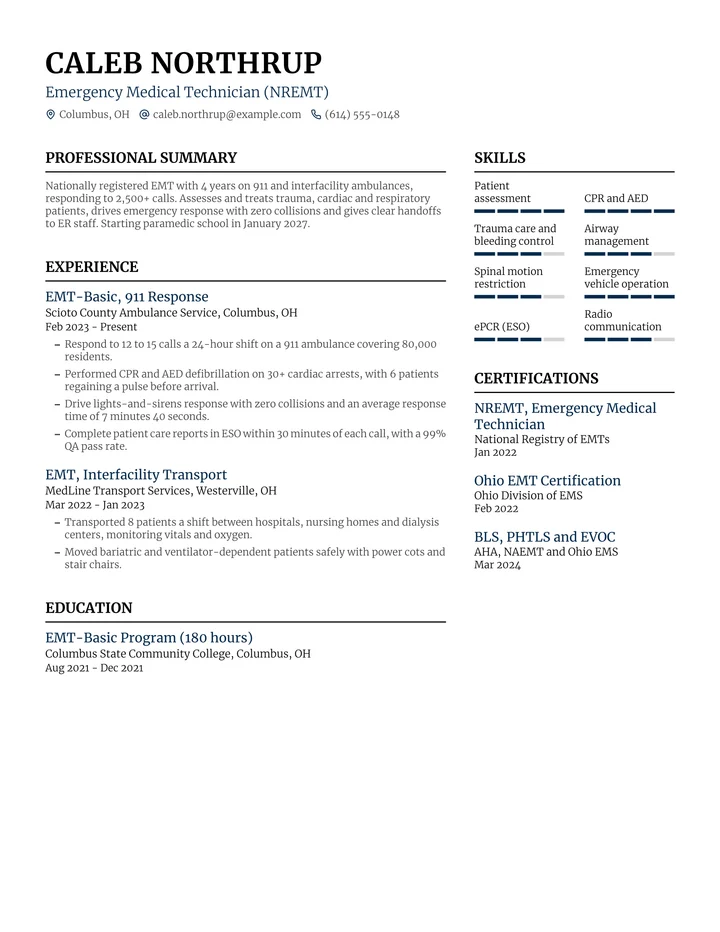
A complete resume for an EMT-Basic on a busy 911 ambulance, plus summaries, bullet points, skills and the certifications to list.
What hiring managers look for
EMS supervisors and hospital recruiters check your certification level and expiration first: EMT, Advanced EMT or paramedic, your National Registry status and your state card. Then they want your setting (911, interfacility transfer, event standby or an emergency department), your call volume, your driving record and the protocols you can work under without being prompted, from spinal motion restriction to CPR with an AED.
This example belongs to an EMT-Basic with four years on a 911 ambulance in a mid-sized city, with a stretch of interfacility transfers before that. The bullets count calls, patients and response times, and the certifications sit near the top where a field supervisor expects them. Volunteer EMTs, ER techs and EMTs studying for paramedic can use the same layout.
EMT resume summary examples
Experienced, 4 years
Nationally registered EMT with 4 years on 911 and interfacility ambulances, responding to 2,500+ calls. Assesses and treats trauma, cardiac and respiratory patients, drives emergency response with zero collisions and gives clear handoffs to ER staff. Starting paramedic school in January 2027.
New EMT
Newly certified EMT with National Registry and state cards, 48 ride-along hours and 10 patient contacts during training. Two years as a lifeguard taught me to stay calm and act fast. Available for 24-hour shifts and eager to start on a 911 or transport crew.
Emergency department tech
EMT working as an emergency department technician in a Level II trauma center, seeing 120 patients a day. Runs 12-lead ECGs, splints, wound care and blood draws, and assists in trauma bays and codes alongside nurses and physicians.
Volunteer to career
Volunteer EMT with 5 years and 900 calls on a rural fire and rescue squad, ready to move into a full-time ambulance role. Experienced with long transport times, extrication scenes and working with mutual-aid crews.
EMT resume bullet points
Strong bullets start with what you did and end with what changed. Borrow the pattern, then use your own numbers.
- Triaged 14 patients at a multi-vehicle crash using START, getting the 3 most critical to a trauma center within the golden hour.
- Recognized stroke symptoms with a FAST exam and called a stroke alert, cutting door-to-CT time to 18 minutes.
- Restocked and checked the ambulance at every shift change, with zero missing-equipment findings in 2 years of audits.
- Gave naloxone to 40+ overdose patients and supported ventilations until they were breathing on their own.
- Precepted 6 EMT students on ride-alongs, signing off on their patient assessments and skills.
- Covered 25 high school football games and festivals as standby EMT, treating 60 patients on site.
- Applied tourniquets and pressure dressings on 15 penetrating trauma calls, controlling bleeding before arrival.
- Taught hands-only CPR to 300 residents at community events with the county's public education team.
Skills for an EMT resume
Skills job postings ask for
- Patient assessment and triage
- BLS, CPR and AED
- Trauma care and bleeding control
- Airway management and oxygen therapy
- Spinal motion restriction and splinting
- Emergency vehicle operation (EVOC)
- Naloxone and glucose administration
- Patient care reports (ESO or ImageTrend)
- Lifting and moving patients
- Radio and dispatch communication
Skills to show in your bullets
- Calm under pressure
- Clear handoffs
- Compassion
- Teamwork with fire and police
- Situational awareness
List the skills a posting names in its own words, and only the ones you can talk about in an interview. Qualities like these read best as results in your bullets, not as a list.
Tips for writing an EMT resume
- 1
Put your level and registry status at the top
Write "NREMT" and your level right in your headline, and list your state card with its expiration. An expired or missing card is the first thing that gets an EMS application set aside.
- 2
Give your call volume and setting
Calls per shift and total calls show how much you've seen. Say whether it was 911, interfacility, event or hospital work, since each one builds different skills.
- 3
Show a clean driving record
Most services want proof you can drive an ambulance safely. EVOC training and a line like "zero collisions in 4 years" answer the question before it's asked.
- 4
Mention where you're headed
If you're in or starting paramedic or nursing school, say so in your summary. Many services support EMTs who are moving up, and it explains why you'd want their schedule.
Certifications EMS employers check
List each card with the issuing body and the expiration or renewal date. Services verify these before an interview, and a quick match with their requirements moves your application forward.
- National Registry certification (NREMT) with your level
- State EMT, AEMT or paramedic certification
- BLS for Healthcare Providers
- Emergency vehicle operator course (EVOC or CEVO)
- PHTLS, PEPP or AMLS
- Hazmat awareness and ICS 100 or 200
Make it yours

Talk instead of writing
Writing about yourself is hard. Talking is easy. A 25-minute call with the resume expert gets you a resume built from your best work.

Fit it to every job
Paste a job posting and get every line tailored to it, in the words the employer uses.

Know it gets read
See what an applicant tracking system reads in your resume, and what to fix, before you apply.
A cover letter to match
Get a cover letter written from your resume for the job you want, ready to send with it.