Firefighter resume example
A complete resume for a career firefighter and EMT, plus summaries, bullet points, skills and the certifications fire departments check.
What hiring managers look for
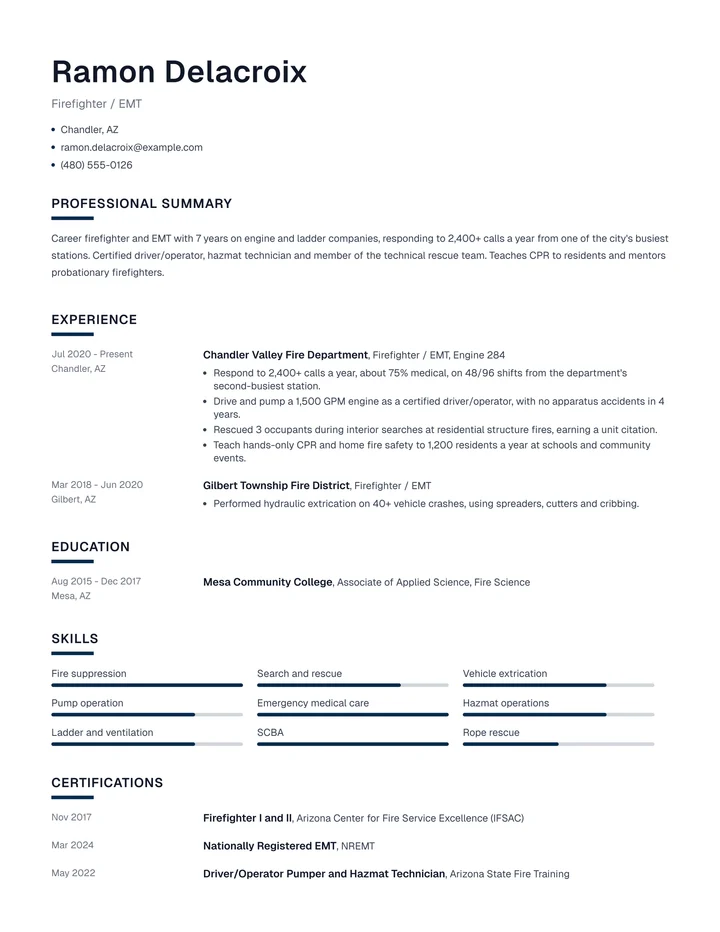
Fire departments screen resumes against a checklist before the written test and agility exam: Firefighter I and II, an EMT or paramedic license, a passed CPAT, a clean driving record and often hazmat operations. Once you clear that list, captains look at your call volume, the apparatus you've driven or operated, specialty teams and how you serve the community off the fire ground.
This example follows a firefighter/EMT with seven years at a busy suburban department after starting as a volunteer. Each bullet counts calls, rescues or training hours, and the certifications are dated so a recruiter can confirm them in one pass. Volunteer, wildland, airport and paramedic firefighters can use the same layout with their own calls and credentials.
Firefighter resume summary examples
Experienced, 7 years
Career firefighter and EMT with 7 years on engine and ladder companies, responding to 2,400+ calls a year from one of the city's busiest stations. Certified driver/operator, hazmat technician and member of the technical rescue team. Teaches CPR to residents and mentors probationary firefighters.
Recruit candidate
Fire science graduate with Firefighter I and II, an EMT certification and a passed CPAT, applying for a first career position. Volunteered 600 hours with a rural district and works as an ambulance EMT, running 12 calls a shift. Clean driving record and ready for the academy.
Paramedic firefighter
Firefighter/paramedic with 10 years on a rescue company, providing advanced life support on 3,000 calls a year. Precepts paramedic students, serves on the department's cardiac arrest review team and helped raise field ROSC rates by 18%.
Military to fire service
Air Force firefighter with 6 years in aircraft rescue and firefighting at two bases, moving to a municipal department. Holds DoD Firefighter I/II, Driver/Operator and Hazmat Technician certifications, plus experience leading a crew of 5.
Firefighter resume bullet points
Strong bullets start with what you did and end with what changed. Borrow the pattern, then use your own numbers.
- Advanced a 1¾-inch handline to the seat of a kitchen fire, holding it to the room of origin.
- Delivered high-quality CPR on 30+ cardiac arrests, with 6 patients regaining a pulse before reaching the hospital.
- Completed 240 training hours a year, including live burns, rapid intervention and confined space drills.
- Cut station equipment check time by 20 minutes a shift by building a shared inventory checklist.
- Served on a wildland strike team for 21 days, building 4 miles of handline on a 30,000-acre fire.
- Rescued a stranded hiker with the technical rescue team using a high-angle rope system in 2 hours.
- Installed 300 ten-year smoke alarms in older homes during a district-wide safety campaign.
- Mentored 5 probationary firefighters through their first-year task books; all passed on schedule.
Skills for a firefighter resume
Skills job postings ask for
- Structural fire suppression
- Search and rescue
- Vehicle extrication
- Emergency medical services (EMT or paramedic)
- Pump and aerial operation
- Hazardous materials response
- SCBA and rapid intervention
- Ventilation and forcible entry
- Incident Command System (ICS)
- Fire prevention and inspections
Skills to show in your bullets
- Physical fitness
- Teamwork under stress
- Discipline
- Community service
- Sound judgment
List the skills a posting names in its own words, and only the ones you can talk about in an interview. Qualities like these read best as results in your bullets, not as a list.
Tips for writing a firefighter resume
- 1
Match the department's minimum list
Most departments publish exact requirements: Firefighter I/II, EMT, CPAT and a license. Name each one in their wording so the screener can check them off.
- 2
Count your calls and your mix
Annual call volume and the share that were medical, fire or rescue tell a captain how much you've seen. Busy stations and combination departments are worth naming.
- 3
Show training beyond the academy
Driver/operator, hazmat, technical rescue, wildland and instructor courses show you keep growing. List hours or the certifying body for each.
- 4
Include service off the fire ground
CPR classes, smoke alarm programs and school visits matter to departments that serve the public every day. Give one bullet with the number of people reached.
Fire service certifications and requirements
Hiring panels compare candidates on the same short list of credentials, so make each one easy to verify with the certifying body and the year. Write them as the posting does; Pro Board and IFSAC seals tell a department your training transfers.
- Firefighter I and II with Pro Board or IFSAC accreditation
- EMT-Basic, Advanced EMT or paramedic, with NREMT or state license
- CPAT or the department's own physical agility test, with the date passed
- Driver's license class and a clean driving record; Driver/Operator if earned
- Hazmat Awareness, Operations or Technician
- Specialty teams such as technical rescue, wildland (S-130/S-190) or ARFF
Make it yours

Talk instead of writing
Writing about yourself is hard. Talking is easy. A 25-minute call with the resume expert gets you a resume built from your best work.

Fit it to every job
Paste a job posting and get every line tailored to it, in the words the employer uses.

Know it gets read
See what an applicant tracking system reads in your resume, and what to fix, before you apply.

A cover letter to match
Get a cover letter written from your resume for the job you want, ready to send with it.