Cybersecurity analyst resume example
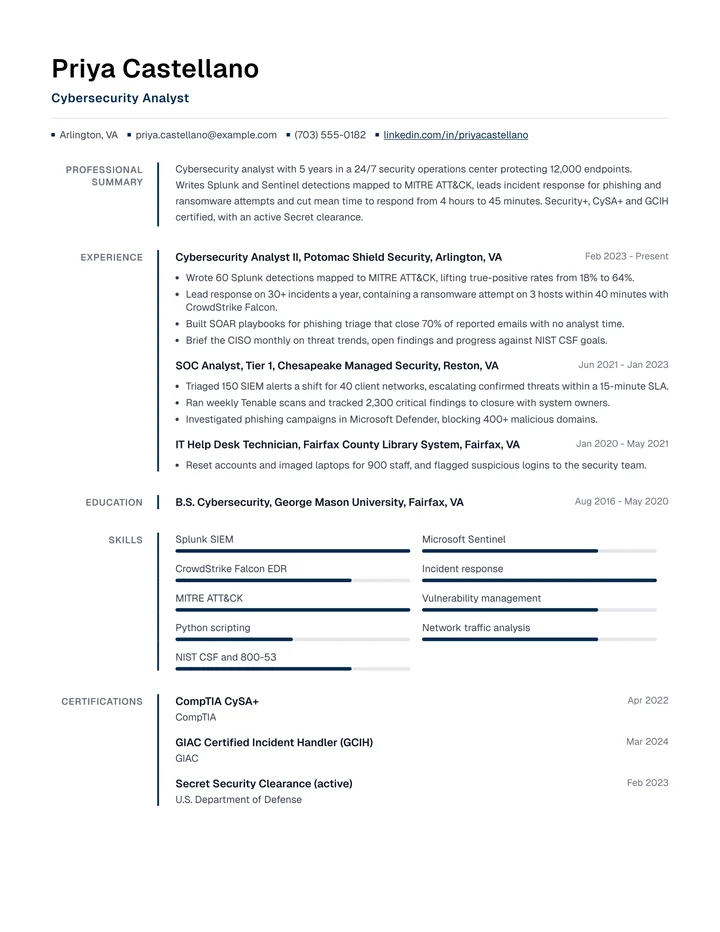
A complete resume for a SOC analyst who moved into detection engineering, plus summaries, bullet points, skills and the security certifications to list.
What hiring managers look for
Security leaders hiring an analyst scan first for certifications such as CompTIA Security+, CySA+ or GIAC, then for the tools you actually run: a SIEM like Splunk or Microsoft Sentinel, an EDR like CrowdStrike Falcon, and vulnerability scanners like Tenable or Qualys. Next they look for proof you can work an incident end to end, measured in alert volume, mean time to detect and respond, and the frameworks you map to, such as MITRE ATT&CK and NIST CSF.
This example follows an analyst with five years in a security operations center, moving from Tier 1 triage to writing detections and leading incident response. Each bullet names the tool, the threat and the result, and a clearance line sits with the certifications for federal and defense postings. SOC analysts, vulnerability analysts, GRC specialists and IT staff moving into security can keep the same layout.
Cybersecurity analyst resume summary examples
Mid-level, 5 years
Cybersecurity analyst with 5 years in a 24/7 security operations center protecting 12,000 endpoints. Writes Splunk and Sentinel detections mapped to MITRE ATT&CK, leads incident response for phishing and ransomware attempts and cut mean time to respond from 4 hours to 45 minutes. Security+, CySA+ and GCIH certified, with an active Secret clearance.
Entry level
Security+ certified graduate with a home lab running Security Onion, Wazuh and a vulnerable Active Directory domain. Placed in the top 10% of a collegiate cyber defense competition and spent a semester as a student SOC analyst triaging alerts for the campus network. Ready for a Tier 1 role on any shift.
Cloud security
Cloud security analyst with 6 years securing AWS and Azure for a fintech company. Rolled out GuardDuty, Security Hub and Defender for Cloud across 80 accounts, closed 1,100 misconfigurations in a quarter and wrote the guardrails that keep public storage buckets from reaching production.
Moving from IT
Systems administrator with 7 years managing Windows servers, Active Directory and firewalls, moving into security operations. Already owns patching, log forwarding and account reviews for 600 users, and earned Security+ and CySA+ while leading the team's first tabletop exercise.
Cybersecurity analyst resume bullet points
Strong bullets start with what you did and end with what changed. Borrow the pattern, then use your own numbers.
- Cut mean time to detect from 9 hours to 50 minutes by tuning 120 noisy SIEM rules and adding threat intelligence feeds.
- Contained a business email compromise within 2 hours, recovering $85,000 in wire funds with the bank's fraud team.
- Ran 4 tabletop exercises a year with IT and legal, turning the gaps found into 25 tracked fixes.
- Drove critical vulnerability patching from 41 days to 9 days by publishing weekly risk scores for each system owner.
- Phished 3,000 employees quarterly in simulations; click rates fell from 22% to 4% over 18 months.
- Hunted for lateral movement across 8,000 endpoints with KQL queries, uncovering 2 dormant backdoor accounts.
- Prepared evidence for a SOC 2 Type II audit that closed with zero security exceptions.
- Automated IOC enrichment in Python, saving the team about 15 analyst hours a week.
Skills for a cybersecurity analyst resume
Skills job postings ask for
- SIEM (Splunk, Sentinel or QRadar)
- EDR (CrowdStrike, Defender or SentinelOne)
- Incident response and forensics
- Threat hunting
- Vulnerability scanning (Tenable, Qualys)
- MITRE ATT&CK
- NIST CSF, 800-53 or ISO 27001
- Firewalls, IDS and IPS
- Packet analysis with Wireshark
- Python, PowerShell or KQL
- Cloud security (AWS, Azure)
- Phishing analysis
Skills to show in your bullets
- Calm under pressure
- Clear incident write-ups
- Curiosity
- Explaining risk to non-technical leaders
- Discretion
List the skills a posting names in its own words, and only the ones you can talk about in an interview. Qualities like these read best as results in your bullets, not as a list.
Tips for writing a cybersecurity analyst resume
- 1
Put security metrics in every bullet
Alerts triaged per shift, mean time to detect and respond, vulnerabilities closed and phishing click rates are the numbers a SOC manager tracks. Use yours, with the before and after.
- 2
Name the tools, not just the category
"SIEM" alone tells a reader little. Write Splunk, Sentinel, CrowdStrike or Tenable, because security postings and applicant tracking systems filter on those exact product names.
- 3
Show you can carry an incident through
Pick one incident and walk it from alert to containment to lessons learned in a single bullet. It proves judgment that a list of tools can't.
- 4
Map your work to a framework
Mentioning MITRE ATT&CK techniques, NIST CSF functions or the CIS Controls shows you understand why a detection or a control matters, not only how to run it.
Certifications and clearances to list
Security hiring leans heavily on certifications, and federal and defense jobs often require a DoD 8140-approved one plus an active clearance before an interview. List each certification with the issuer and year, keep expired ones off, and state your clearance level and whether it's active, without any investigation details.
- CompTIA Security+ (the usual baseline for Tier 1 and government roles)
- CompTIA CySA+ or GIAC GCIA for detection and analysis work
- GIAC GCIH or GCFA for incident handling and forensics
- CISSP or CISM once you have five years and move toward leadership
- Cloud credentials such as AWS Certified Security - Specialty or Microsoft SC-200
- Security clearance level (Secret, Top Secret, TS/SCI) and whether it's active
Make it yours

Talk instead of writing
Writing about yourself is hard. Talking is easy. A 25-minute call with the resume expert gets you a resume built from your best work.

Fit it to every job
Paste a job posting and get every line tailored to it, in the words the employer uses.

Know it gets read
See what an applicant tracking system reads in your resume, and what to fix, before you apply.

A cover letter to match
Get a cover letter written from your resume for the job you want, ready to send with it.